The memory of the Rroma genocide reminds us that human dignity cannot depend on a person’s origin, identity or status.
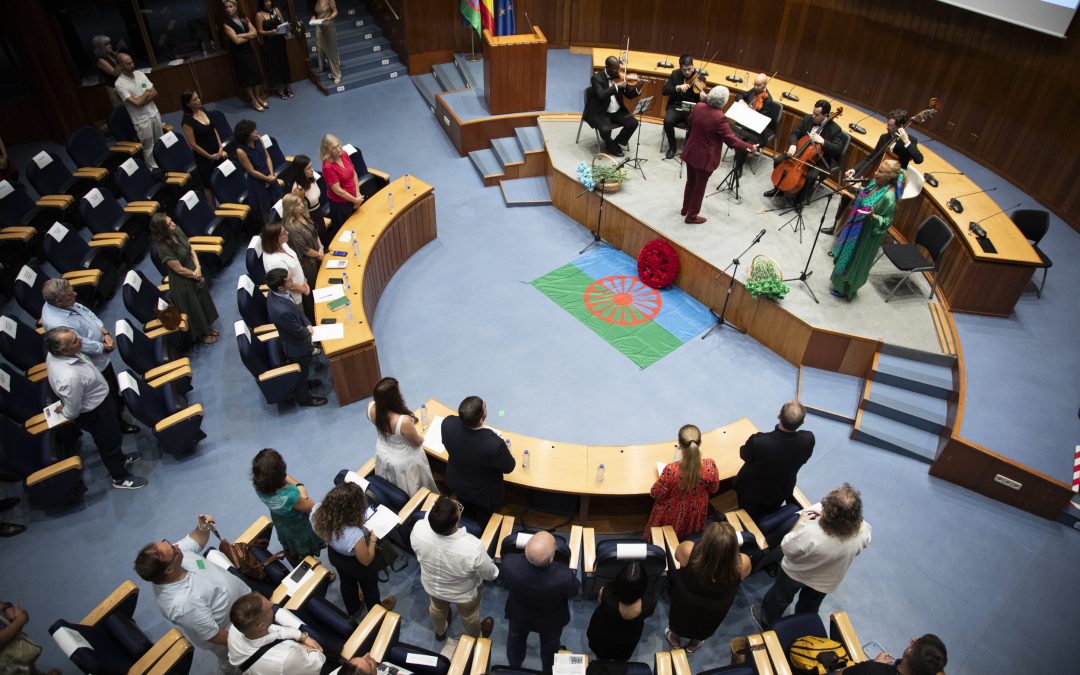
La Fragua Projects took part in the Samudaripen Memorial 2026, an event of remembrance and recognition dedicated to the victims of the genocide of the Rromani People during the Nazi era. The event brought together representatives from institutions, social organisations and Rromani organisations to pay tribute to those who were persecuted and murdered by the Nazi regime, and to call for the pledge of ‘never again’ to become a genuine commitment to human rights, equality and the dignity of all people.
The memorial was a space for remembrance, reflection and collective commitment. A place to honour the memory of those who suffered persecution and extermination, but also to reaffirm the need to continue fighting racism, intolerance and any form of dehumanisation in the present day.
Remember so as not to repeat
Samudaripen, which in Rromani means «total murder» or «the great slaughter», is the term used by the Rromani People to commemorate the genocide perpetrated by the Nazi regime and its collaborators during the Second World War. The Rromani and Sinti communities were persecuted, deported and murdered on racial grounds in a campaign of extermination that claimed the lives of hundreds of thousands of people across Europe.
2 August marks the European Day of Remembrance for the Victims of Samudaripen. The date commemorates the night of 2–3 August 1944, when the Nazi authorities liquidated the so-called Zigeunerlager or «Rromani family camp» at Auschwitz-Birkenau, murdering thousands of men, women and children who were being held prisoner there.
However, the legacy of the Samudaripen is not merely about remembering a historical tragedy. It also forces us to ask ourselves how it was possible for a society to accept that part of its population should be singled out, excluded and ultimately exterminated.
Because no genocide begins with murders.
First come the prejudices. First come the narratives that turn difference into a threat. First, discrimination becomes the norm. First, the dignity of those perceived as different is called into question.
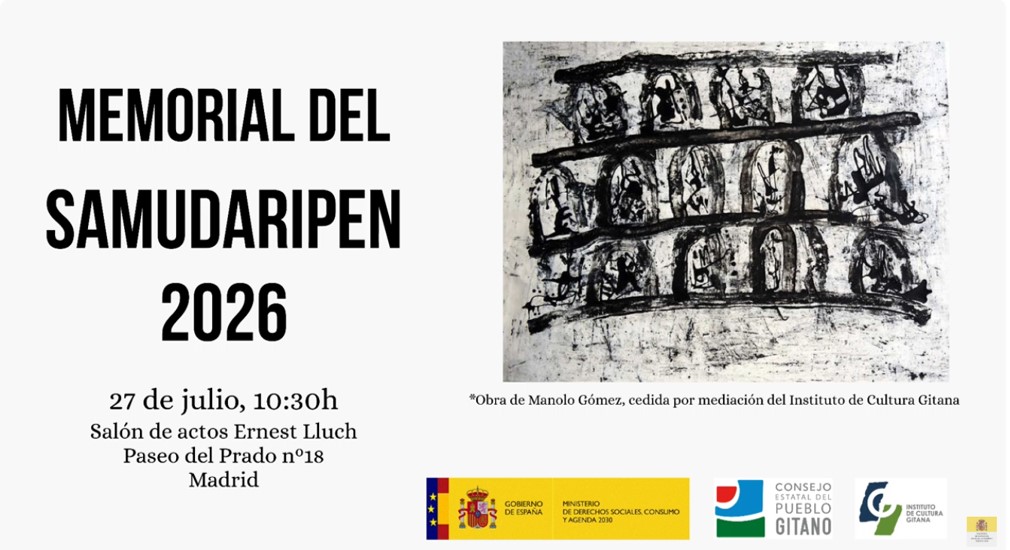
Poster for the 2026 Samudaripen Memorial
A memoir that challenges the present
For the Rromani People in Spain, this report also ties in with another pivotal episode in our history: the General Round-up of Rroma (La Gran Redada) of 1749, when approximately 12,000 Rroma people were arrested, separated from their families and deprived of their liberty in an operation designed to destroy their way of life and their collective identity.
Although separated by centuries, the Great Round-up and Samudaripen share the same root cause: the persecution of people on the basis of their origin and the formulation of policies based on exclusion.
That is why remembrance remains necessary.
We live in a world marked by armed conflict, forced displacement, hate speech and human rights abuses that affect millions of people. Given this reality, remembering the past ceases to be merely a historical exercise and becomes an ethical responsibility.
The lessons of Samudaripen remain relevant today because violence begins long before weapons are involved. It begins when we cease to recognise the humanity of those in front of us.
La Fragua Projects at the Memorial
The Samudaripen Memorial also served as a place to remember all the people and communities who were persecuted by the Nazi regime on the grounds of ethnicity, religion, sexual option, politics, ideology, or simply for being considered different.
During the event, a series of statements and messages were delivered, focusing on remembrance, recognition and a commitment to human rights, emphasising the need to build an inclusive memory that leaves no victim behind.
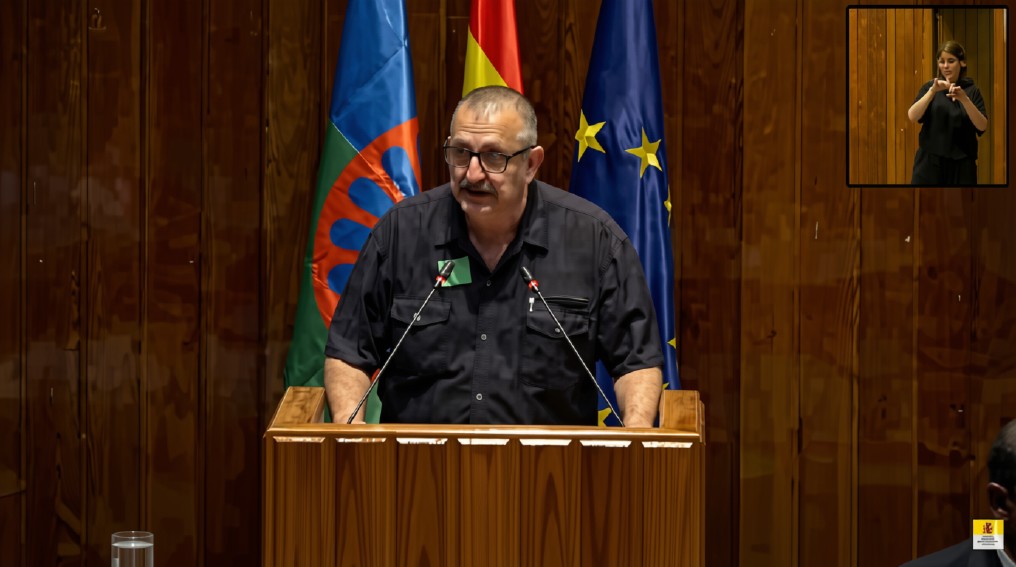
On behalf of La Fragua Projects, our colleague Iñaki Vázquez Arencón took part in one of the most moving moments of the day, saying the following:
“For all Jewish people, LGBTIQ+ people, people with disabilities and all those who, because of their circumstances, were persecuted and murdered by the Nazi regime.”
A statement which served as a reminder that memory cannot be built on the basis of forgetting or exclusion.
Remembering the Samudaripen also means acknowledging the suffering of all those who fell victim to Nazism and keeping alive our commitment to a society based on equality, diversity and respect for human dignity.
Because when a person’s dignity is attacked, the dignity of all humanity is put at risk.
Let «never again» be a genuine commitment
The Samudaripen Memorial is not merely a commemoration.
It is a call to action.
To challenge prejudices wherever they arise.
To combat racism and discrimination in all their forms.
Let us reject hate speech.
To defend human rights with the same determination for everyone.
Let us build societies where no one has to live in fear because of their background, identity, beliefs or way of life.
At La Fragua Projects, we believe that memory only has meaning when it serves to transform the present.
Because Samudaripen forms part of the memory of the Romani people, but also of the democratic memory of Europe and of humanity.
Remembering this means defending human dignity today, combating racism and rejecting all forms of hatred or dehumanisation.
Only in this way will «never again» cease to be a phrase uttered at commemorative events and become a shared responsibility with the present and with future generations.
As part of the ‘Orgullo Gitano. Sevilla 2026’ event, three declarations have been presented which set out a collective stance and launch a nationwide process aimed at strengthening the rights of LGBTIQ+ Rromani people.
These documents stem from the opportunities for participation created during the meeting and reflect a clear commitment to recognising sex and gender diversity within the Rromani community as a historical, political and social reality that requires recognition, resources and specific responses.
Three complementary perspectives for a shared agenda
The statements relate to three distinct areas, which have made it possible to explore specific experiences and needs in greater depth from a context-specific perspective.
On the one hand, the Aliades Space Declaration highlights the role of the alliance as a tool for transformation. The document argues that change cannot rest solely with those who suffer discrimination, but requires the active involvement of other social actors, based on shared responsibility and sustained commitment.
The text emphasises that being an ally is not merely a symbolic stance, but a practical commitment that involves examining one’s own privileges, taking action against inequalities and helping to create safer and more inclusive environments.
Furthermore, the GTBIQ Space Declaration, which focuses on Rromani men and non-binary people, directly addresses the intersection between anti-Romani sentiment and LGTBIQphobia. The document highlights how these forms of discrimination reinforce one another and give rise to specific situations of exclusion.
It also emphasises the need to establish role models, strengthen networks and move towards a political agenda of its own that will enable these issues to be placed at the centre of public debate and public policy.
The LBTIQ Space Declaration, which focuses on Rromani women and non-binary people, highlights their historical invisibility, the silence surrounding their experiences, and the material and emotional impacts of discrimination.
The document highlights the importance of reclaiming collective memory, creating spaces of their own and strengthening leadership that enables Romani women and people of diverse gender identities to participate fully in social, community and institutional life.
From reflection to the establishment of a national network
Beyond the analysis, the three documents share a common goal: the establishment of a national network of LGBTIQ+ Rroma people.
This proposal is not merely intended as an organisational structure, but as a space for mutual support, the generation of our own knowledge and political advocacy. It is a necessary step towards overcoming the current fragmentation and moving towards collective responses to inequalities.
The statements also highlight the limitations of current public policies, which in many cases fail to incorporate an intersectional perspective capable of simultaneously addressing anti-Rroma bias and sex and gender diversity.
A starting point for a sustained process
The Seville Statements 2026 is not intended to provide a definitive assessment, but rather to mark the start of a new phase.
A process that places dignity, equality and human rights at its heart, and which positions LGBTIQ+ Rroma people as key players in developing responses to discrimination.
From this starting point, the challenge is no longer simply to share a common framework, but to translate it into concrete actions, genuine partnerships and sustainable change over time.
The Madrid Summit brought together activists and organisations in Madrid to tackle LGBTIQ+ issues, in a forum where the voices of Rroma people are still missing.
On 3 July, Madrid hosted the latest edition of the Madrid Summit, MADO’s international human rights conference, which focused on defending LGBTIQ+ rights in a context characterised by polarisation, hate speech and various setbacks at a global level.
Held at the offices of the European Parliament and the European Commission in Spain, the event brought together activists, institutional representatives, experts and civil society organisations, who shared their analyses and proposals for tackling the inequalities that continue to affect the lives of this community. The full event can be watched again via the Madrid Summit 2026 broadcast.
During the Summit, key issues were addressed, such as the historical memory of LGBTIQ+ people who have suffered reprisals, trans rights, the situation of migrants and refugees, and the role of sport as a space for inclusion. The programme once again highlighted that discussing human rights means starting from the specific realities in which discrimination remains a reality.
Madrid: visibility and inequalities
Madrid is a beacon for the LGBTIQ+ movement, a space for visibility, organisation and mobilisation. But this central role coexists with a more complex reality: the city continues to be rife with inequalities, racism and LGBTIQ+phobia, which affect people differently depending on their background, social class or identity.
Not everyone in Madrid enjoys equal opportunities. For many, particularly those who belong to racialised communities such as the Rromani people, access to rights, safe spaces and a life free from discrimination remains a daily challenge.
Broadening the debate: a Rromani, anti-racist and feminist perspective
In this context, La Fragua Projects’ stance offers a much-needed perspective. As a Rromani, anti-racist and LGTBIQ+ organisation, its presence at the Madrid Summit highlights a fundamental issue: the defence of LGTBIQ+ rights cannot be understood without addressing racism, anti-Rromani sentiment and other forms of structural exclusion.
Being present in these spaces also means highlighting their limitations. At present, the participation of LGBTIQ+ Rroma People remains low in many such forums, which makes it difficult for their experiences and realities to form a central part of the debate.
It is not just about being present, but about participating on an equal footing: being heard, influencing the agenda and having a say in the decisions that affect our lives.
Rights exercised in everyday life
Talking about equality cannot be limited to mere rhetoric. It means asking who can live in safety, who is able to exercise their rights in practice, and who continues to face barriers to exercising them.
Along the way, it is also important to establish a presence, forge alliances and create spaces for dialogue – which are not always comfortable, but are necessary if we are to move towards a fairer society.
A challenge that remains unresolved
The Madrid Summit 2026 once again made it clear that LGBTIQ+ rights are not guaranteed and need to be defended constantly and collectively. But it also highlighted that such defence will only be complete if it includes all voices.
Because equality is not just about being present. It is about being able to take part in the conversation and in decision-making.
It is presented at the annual plenary session of the Xarxa BCN Antirumors held on June 26.
The organisation presents a proposal focused on meaningful participation, impact evaluation and transforming public narratives, in the context of the 15th anniversary of the municipal strategy.
On 26 June, the Palau Alòs Youth Centre became a meeting point to reflect on the present and future of the BCN Anti-Rumour Network. In a session marked by shared experiences and critical thinking, Imma Anegas González and María Aguilera Martín, representing La Fragua Projects, played a key role by presenting their proposal for the development of the new 2027–2031 action plan.
An important step at a key moment: fifteen years after the strategy began, in a context where hate speech is intensifying and taking on new forms.
A proposal to bring anti-racism into real policies
Far from being a purely theoretical document, La Fragua Projects’ proposal is designed as a practical tool for the Network and the city. The goal is clear: to strengthen the Network’s role as a key actor within public policies to combat racism.
As presented, the new plan is an opportunity to consolidate the Network’s capacity to influence, improve its monitoring mechanisms and ensure that its actions have a real impact on people’s lives.
To achieve this, the proposal is built on three key ideas. First, co-creation with organisations, recognising that participation cannot be symbolic but must shape decision-making. Second, a culture of evaluation, capable of measuring not only activities, but real changes in perceptions, narratives and social relations. And finally, operability: turning strategies into concrete and viable actions.
As highlighted during the presentation itself, this is a plan “built with organisations” and designed to be adapted along the way, with a clear objective: to generate impact in everyday life.
A participatory process with a critical perspective
The methodological approach presented by La Fragua Projects structures the plan into several phases: analysis of previous work, consultation with organisations, definition of priorities and final validation.
A central element is the design of more useful and accessible participatory spaces, aimed at enabling genuine involvement from organisations, especially those that have traditionally been underrepresented.
In addition, the plan incorporates an intersectional and intercultural approach, alongside a critical perspective that challenges the structures that sustain inequalities.
A day combining reflection and lived experience
The presentation of the plan was part of at the annual plenary session, where the results of the Network’s participation study were also shared and spaces for dialogue about its future were opened.
Interventions such as that of Richard Sánchez, who stated that “what used to be rumours are now hate speech”, placed the debate within the urgency of the current context.
The interview with Yousra Touri El Mansouri and the screening of the short film “Serem el que sempre hem desitjat” brought in lived experiences, while voices such as Doris Boira Bueso highlighted the importance of creating real spaces for dialogue to confront racism.
A new cycle for the Network
The proposal presented by La Fragua Projects opens a new chapter for the BCN Anti-Rumour Network. A chapter that is not only about planning, but about the ability to transform realities.
As became clear during the session, the key is not only to design a strong plan, but to build it alongside those who sustain the work on the ground and ensure that this effort translates into concrete change: fewer hate narratives, more spaces for dialogue and a more just city for everyone.
Source: La Fragua Projects Photos: La Fragua Projects
This is the first LGBTIQ+ Rromani gathering in Spain since 2017, aimed at building networks, raising awareness of people’s experiences and creating safe spaces
Two days of activities, dialogue and culture have shaped the first LGBTIQ+ Rromani gathering in Seville since 2017 – and the first of its kind in Andalusia and Seville – a pioneering initiative that places the voices of Rromani gender and sexual diversity at the centre, alongside their right to live with dignity, without fear and as part of a community.
On 18 and 19 June 2026, the Hogar Virgen de los Reyes in Seville hosted a gathering that went far beyond the official agenda. Above all, it was a space to assert our identities, recognise one another and collectively build new ways of being and resisting racism and LGBTIphobia.
The programme combined private, safe spaces with activities open to the public, striking a balance between personal care and social visibility.
A safe space to start sharing
The first day began with a safe space session aimed at LGBTIQ+ Rroma People, designed as a protected space where they could speak from their own experience. From the welcome session through to the group discussion sessions (LGBTIQ, GTBIQ and allies), the day focused on building trust, sharing experiences and putting into words realities that are often left out of the public narrative.
These discussions addressed key issues such as relationships with family and the community, the experience of living in the closet, and the need to have one’s own support networks. The session concluded with a group discussion which also served to raise a question for the future: what role should a potential LGBTIQ+ Rromani network play, and what priorities should it set?
Far from being a mere exchange of ideas, the meeting took shape as a first concrete step towards collective action.
Activism, culture and critical thinking
On the afternoon of 18 June, the programme broadened its scope with a series of open discussions bringing together activists, thinkers and cultural figures. Over the course of several hours, topics such as culture as a tool for transformation, Rromani transfeminism and tensions with hegemonic masculinity both within and outside the community were explored.
The contributions went beyond theory. They addressed specific lives, real conflicts and strategies for tackling violence. Within this framework, the reading of the ‘Seville 2026 Declarations’ gave a collective voice to the demands and reflections arising from different perspectives: LBTIQ and GTBIQ Rroma people and their allies (both Rroma and non-Rroma).
The event also incorporated artistic expression, with audiovisual screenings and a symbolic closing ceremony featuring a toast to Rroma Pride. A simple gesture which, in this context, takes on a profound meaning: celebrating existence, pride and the right to be.
Culture to open up cracks
The event was not limited to talks. The cultural programme played a central role, featuring a performance of the play ‘Puños de harina’ and book launches such as ‘Biopolítica del Armario’ and ‘Propaganda Queer’.
These proposals broadened the narrative by drawing on other languages, demonstrating how culture can also be a political tool and a space for resistance.
Pioneers who lead the way and recognition that matters
One of the symbolic moments of the event was the recognition of the actress Alba Flores as an LGBTIQ+ role model. This recognition took place as part of the 2nd LGBTIQ+ Awards Gala, where she was honoured in the ‘Role Model’ category alongside other key figures.
The award, nominated and accepted on her behalf by La Fragua Projects, through Iñaki Vázquez and Celia Montoya, highlights the importance of having visible role models who pave the way, especially for those who grow up without role models to look up to.
Alongside Alba Flores, the contributions of others – such as Shannis’s work in defending trans rights – were also recognised, broadening the focus to include other vital struggles within the LGTBIQ+ movement. This kind of recognition is not merely symbolic: it helps to shape our collective narrative, memory and vision.
A first step that leaves its mark
This first LGTBIQ+ Rromani gathering has not merely been an event, but a starting point. It has served to give a voice to a reality that exists, even though it has historically been rendered invisible, and to forge the first connections in a network that aims to continue growing.
In a context where anti-Rroma sentiment and LGBTI-phobia continue to shape people’s lives, initiatives such as this are not only necessary: they are urgent. The experience in Seville has left those who took part with a shared conviction: when people create their own safe, collective spaces, things happen.
And this was just the first one.
Source: La Fragua Projects Images: La Fragua Projects Photo: Alba Flores
Utilizamos cookies para optimizar nuestro sitio web y nuestro servicio.
Funcional
Always active
El almacenamiento o acceso técnico es estrictamente necesario para el propósito legítimo de permitir el uso de un servicio específico explícitamente solicitado por el abonado o usuario, o con el único propósito de llevar a cabo la transmisión de una comunicación a través de una red de comunicaciones electrónicas.
Preferencias
El almacenamiento o acceso técnico es necesario para la finalidad legítima de almacenar preferencias no solicitadas por el abonado o usuario.
Estadísticas
El almacenamiento o acceso técnico que es utilizado exclusivamente con fines estadísticos.El almacenamiento o acceso técnico que es utilizado exclusivamente con fines estadísticos anónimos. Sin una requerimiento, el cumplimiento voluntario por parte de su proveedor de servicios de Internet, o los registros adicionales de un tercero, la información almacenada o recuperada sólo para este propósito no se puede utilizar para identificarlo.
Marketing
El almacenamiento o acceso técnico es necesario para crear perfiles de usuario para enviar publicidad, o para rastrear al usuario en un sitio web o en varios sitios web con fines de marketing similares.