La Fragua Projects is organising a participatory event with an anti-discrimination focus to highlight the structural violence faced by the Romani People, with a particular focus on women.
On 21 May, the Las Góndolas Community Centre in Seville East hosted the participatory conference “Intersectional Discrimination and the Roma People 2025”, organised by La Fragua Projects, a Roma organisation within the social and solidarity economy that provides comprehensive services.
The event forms part of the DiscriRromani Sevilla-DCR 2025 programme, which has been run by Seville City Council since January with the aim of tackling the structural discrimination faced in particular by Roma and racialised women, using an anti-discriminatory and intersectional approach.
The event was hosted by Celia Montoya Montoya, an actress, activist and founding partner of La Fragua Projects, who welcomed the audience and emphasised the need for an anti-discriminatory and intersectional approach that extends beyond Seville’s society.
The opening address was given by José Luis García Martín, the representative for the Department of Priority Neighbourhoods and Social Rights, who emphasised that “we cannot speak of full democracy if there are communities, such as the Roma, that remain excluded from the most basic rights”, and that “there can be no justice without full recognition of these rights”.
Her speech emphasised the need to address the discrimination faced in particular by Roma women, and she highlighted the participatory nature of this event as a tool for social change. Her remarks were followed by a panel of presentations featuring several experts.
Multiple forms of violence: health, education and social services
The first presentation was given by Virginia García Linde, a political scientist and social research specialist, who spoke on the topic of “Health and obstetric violence” and describes herself as an advocate for the humanisation of childbirth.
She has portrayed childbirth as an intimate, private and domestic event, whilst also providing a historical overview of the role of the midwife and paying tribute to all those Romani women who carried out this work and were executed in contexts of criminalisation after being accused of witchcraft. At the same time, she has condemned the medicalisation of childbirth driven by patriarchal and capitalist logic.
In this regard, she has highlighted the experiments carried out on women and the cruel practices perpetrated against black women by some of the ‘fathers’ of gynaecology, as well as controversial instruments that are still in use today.
It is therefore impossible not to mention hierarchy, given that, at present, it is predominantly men who are present at births. In contrast to the care and good medical practice required to support this vital natural process, hospitals are increasingly trying to speed up the delivery process, which entails various forms of violence against pregnant women.
In the context of this conference, she mentioned that verbal abuse and anti-Roma sentiment are factors in obstetric violence. From the educational sector, Laura Páez Hurtado, a member of the teaching staff and a specialist in therapeutic pedagogy, addressed the topic of ‘Education’. In this regard, she highlighted the reality faced by many schools with pupils at risk of social exclusion: the lack of Roma representation on the parents’ association, persistent truancy and the worrying impact of socio-economic conditions.
She has also shared transformative experiences from her school, such as the celebration of Roma Day with a gender perspective, with a view to increasing the involvement of the entire school community and promoting harmony, as well as various initiatives aimed at challenging traditional concepts found in classic stories or festivities such as Valentine’s Day.
In doing so, he has highlighted the need to include the Roma community in the education sector and the importance of equality plans.
For her part, Ana León Távora, Professor of Spanish Language and Literature at Salem College (USA), in her section “Anti-racist education and experience of working with migrant students”, highlighted the need for anti-racist education that enables the dismantling of myths and stereotypes about immigration and a rethinking of cultural roots from a decolonising perspective.
Drawing on the history of imagery and symbolism, he teaches his students the importance of anti-racist education in enabling them to think critically and avoid being misled, as well as in combating ignorance, since perspectives and their inherent biases shape the knowledge we receive and, consequently, often internalise. “Racism is significant because it divides,” he stated.
The final speaker was Séfora Vargas Martín, a Romani lawyer, writer and activist, personal and leadership coach, as well as president of the Aproideg association and a consultant for DiscriRomani Sevilla 2025, a contributor to the Roma Professional Network and La Fragua Projects. Speaking from her own experience, she highlighted the degrading treatment that many Roma women receive from some social services staff, as well as the overwhelming fear of reporting such incidents due to fear of reprisals, institutional mistrust, or even the concern that non-Roma women might find out about these complaints.
He also highlighted the importance of mediation in ensuring equal treatment for the Roma community, given that people turn to social services due to financial hardship. He also denounced the presence of racist officials, the lack of care, and the prevalence of common accounts among those affected by, amongst other issues, waiting times for care, as well as the need to alleviate, communicate or educate in the face of the dehumanisation suffered by the Roma people from childhood.
Participation and collective horizons
Subsequently, round-table discussions and working groups were organised as a participatory format involving those attending the event, with the aim of drawing conclusions based on the various key themes.
These contributions will help shape the programme’s annual report, thereby ensuring that the document is drawn up on the basis of a diversity of voices.
Against a backdrop of rising anti-Gypsyism and institutional racism, this gathering has provided a forum not only for speaking out, but also for collective action. It is undoubtedly another step forward in the struggle for a society in which the Roma people are not merely present, but fully recognised and heard.
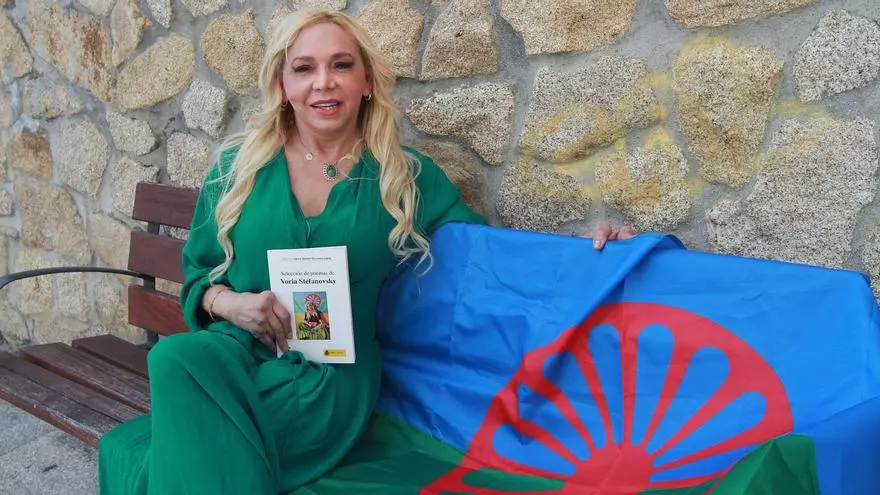
International Roma Day, celebrated yesterday, was a day of advocacy for the Rroma People. Voria Stefanovsky, an activist and academic based in Ourense, is a leading voice in the fight for her community’s dignity, and this year she is marking the occasion with a bilingual collection of poems in Spanish and Romani.
Yesterday marked International Rroma Day, an occasion that Voria Stefanovsky uses every year to stand as a beacon of advocacy and visibility for the Romani people from Ourense, a city she fell in love with a couple of years ago. She has made her home there and, from the city of As Burgas, runs the International Observatory for Rromani Women, which takes on even greater significance this year, marking 600 years of the Romani presence on the Iberian Peninsula.
However, beyond the historical commemorations, the focus is on this author, activist and academic, whose work and life are deeply intertwined with the struggles of the Rromani people.
Voria Stefanovsky holds a PhD in Literature from the University of Brasília and is currently undertaking postdoctoral research at the University of Lisbon, focusing on literature written by Rromani women. However, her most recent contribution has been a collection of poems published by the Institute of Rromani Culture, through which Stefanovsky seeks to “reclaim and restore dignity to a language which, after centuries of repression, remains one of Spain’s greatest historical debts to the Rromani community”.
The publication of this book is not an isolated event, but part of a process of raising awareness that has been developing for years and in which the Institute of Rromani Culture, a body under the Ministry of Culture, has played a key role, organising, among other things, an annual gala which has become a vital platform for showcasing the art and contributions of the Rromani people and which is held every year on 8 April.
Stefanovsky was, in fact, one of the award winners at this event, although this was back in 2022 for his research into Romani literature as part of his doctoral thesis – a milestone he hopes to repeat with his postdoctoral work, a body of writing he combines with the production of articles and poems such as those included in the Institute of Gypsy Culture’s collection.
The bilingual collection of poems
Stefanovsky’s collection of poems is not merely a literary work; it is a political and cultural statement. Through her verses, the author addresses themes that ‘run through the history of the Rromani people, because we are a transnational nation; we are present in many countries, yet we share the same culture and the same traumas’, says the writer, who counts amongst her themes ‘persecution, resistance and attempts at forced assimilation’.
Her poems, imbued with “a deeply autobiographical element”, also serve as a mirror for “the experiences of other Rromani women, because what I have been through is not unique to me; I’m sure it’s a story similar to that of many other women who have survived”, she reflects.
Among the works included in the anthology, Voria highlights the poem ‘Caminantes’, in which he reflects on ‘the history of the Romani people as a travelling people, always on the move, always persecuted, but always resilient’, emphasising the idea of a ‘transnational nation’ and the ‘constant struggle to preserve culture and identity in the face of imposed attempts at acculturation’.
What makes this collection of poems so important, apart from its message, is its bilingual format; the texts are in both Spanish and ‘Rromani, the native language of the Rromani people, which has been systematically oppressed for centuries, to the point of near extinction in many regions of Spain, such as in the south, where ‘caló’ was adopted as an adaptation of the two languages’. Thus, with the publication of this book, Stefanovsky is not only asserting his right to write in his mother tongue, but also ensuring that it becomes a vehicle for the revival and dissemination of this language.
The work is available in both physical and PDF formats, and is accessible freeof charge to encourage its reading and preservation. “It’s poetic activism,” argues this woman, who is proud to be Rromani, emphasising that “there is still a long way to go before the Rromani community receives the recognition it deserves, because it must stop being viewed as a welfare issue; what is needed is historical redress, which can only be achieved through rights and recognition.”
The FEIG project is organising a superb debate at the Parliament of Navarre, with the invaluable support of the Gaz Kaló Federation, which is hosting the event
On 26 March 2025, the Parliament of Navarre hosted a conference on theImpact of Strategies for the Rroma People in Navarre, organised as part of the 2025 Inter-Regional Roma Strategic Forum (FEIG 2025). This is a pilot project funded by the Ministry of Social Rights, Consumer Affairs and the 2030 Agenda, which aims to contribute to the implementation, monitoring and follow-up of the National Strategy for the Equality, Inclusion and Participation of the Rroma People 2021–2030 from a regional perspective.
The conference was opened by the President of the Parliament of Navarre, Unai Hualde, who noted that “the Rromani People and Navarre share centuries of history and coexistence, and it is only in recent parliamentary terms that a specific strategy has been developed for the advancement of the Romani community, taking a cross-cutting approach to both the issues involved and the stakeholders involved”.
“Events such as this should serve to analyse the progress and results achieved through the work of the institutions and Rroma associations in our region, whilst also providing an insight into the work being carried out at national level and in other regions,” said Hualde.
Inés Jiménez, Director-General for Social Protection and Development Cooperation at the Government of Navarre, went on to state that “the Strategy for the Development of the Roma Community in Navarre, despite having been drawn up before the National Strategy, shares its structure with the latter through three main pillars: equal treatment, inclusion and the Roma community’s participation in society”.
For his part, Fabián Daniel Sánchez, a representative of FEIG, thanked Parliament for being “the first legislative chamber in the country to host a conference organised by the Forum itself”.
“As we mark the 600th anniversary of the arrival of the Rroma in Spain in 2025, we must highlight the undeniable contributions our people have made to Spanish society as a whole, but we also need to make a stand that will help us make progress towards equal opportunities,” he said.
“We have been living, working, dreaming and building this land for 600 years. Let’s make Navarre a community free from antigypsyism,” he concluded.
Finally, Pascuala Amador, from Gaz Kaló, acknowledged “antigypsyism as one of the scourges from which the Rroma People suffers most”, which is why she called for “strategies to be turned into useful tools not only for the Rroma community itself, but also for public authorities and society as a whole”.
This was followed by an introduction to the Inter-Regional Rroma Strategic Forum, focusing on aligning regional strategies with the National Strategy and the European Framework for the Equality, Inclusion and Participation of the Rroma People (2021–2030). The presentation was led by Bianca Elena Galusca, from the Federation of Rroma Associations of Catalonia (FAGIC), and Iñaki Vázquez, representative of La Fragua Projects (LFP).
This was followed by a round-table discussion on the main findings of the evaluation of the Rroma Strategy in Navarre, which, moderated by Víctor Sánchez (UPNA), facilitated an exchange of views between the Regional Government’s Department of Social Rights, Social Economy and Employment, civil society organisations in Navarre and parliamentary groups.
In addition, a participatory debate was held by the Assembly of the Inter-Regional Rroma Strategic Forum (FEIG).
Finally, the event was brought to a close by Fabián Daniel Sánchez, representing the National Association for the Presence of the Rroma (ANPG).
Note from La Fragua Projects: The participation of civil society representatives was also particularly noteworthy, and they highlighted the need to take decisive and coordinated action alongside migrant, refugee, Rroma and racialised communities in order to tackle far more effectively the structural disadvantages they face – disadvantages that can only be reversed through public policy.
Source: Parliament of Navarre and La Fragua Projects Photos: Miguel Oses (Parliament of Navarre)
Utilizamos cookies para optimizar nuestro sitio web y nuestro servicio.
Funcional
Always active
El almacenamiento o acceso técnico es estrictamente necesario para el propósito legítimo de permitir el uso de un servicio específico explícitamente solicitado por el abonado o usuario, o con el único propósito de llevar a cabo la transmisión de una comunicación a través de una red de comunicaciones electrónicas.
Preferencias
El almacenamiento o acceso técnico es necesario para la finalidad legítima de almacenar preferencias no solicitadas por el abonado o usuario.
Estadísticas
El almacenamiento o acceso técnico que es utilizado exclusivamente con fines estadísticos.El almacenamiento o acceso técnico que es utilizado exclusivamente con fines estadísticos anónimos. Sin una requerimiento, el cumplimiento voluntario por parte de su proveedor de servicios de Internet, o los registros adicionales de un tercero, la información almacenada o recuperada sólo para este propósito no se puede utilizar para identificarlo.
Marketing
El almacenamiento o acceso técnico es necesario para crear perfiles de usuario para enviar publicidad, o para rastrear al usuario en un sitio web o en varios sitios web con fines de marketing similares.