The verses of the Rromani resistance
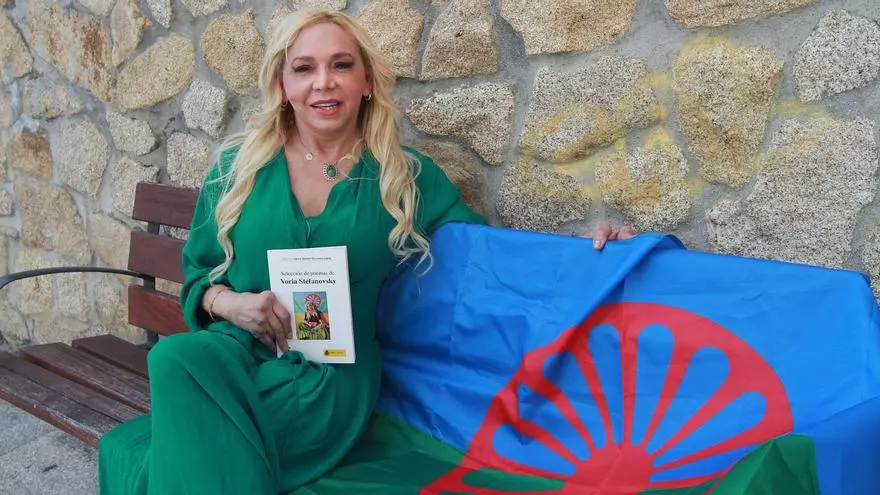
International Roma Day, celebrated yesterday, was a day of advocacy for the Rroma People. Voria Stefanovsky, an activist and academic based in Ourense, is a leading voice in the fight for her community’s dignity, and this year she is marking the occasion with a bilingual collection of poems in Spanish and Romani.
Yesterday marked International Rroma Day, an occasion that Voria Stefanovsky uses every year to stand as a beacon of advocacy and visibility for the Romani people from Ourense, a city she fell in love with a couple of years ago. She has made her home there and, from the city of As Burgas, runs the International Observatory for Rromani Women, which takes on even greater significance this year, marking 600 years of the Romani presence on the Iberian Peninsula.
However, beyond the historical commemorations, the focus is on this author, activist and academic, whose work and life are deeply intertwined with the struggles of the Rromani people.
Voria Stefanovsky holds a PhD in Literature from the University of Brasília and is currently undertaking postdoctoral research at the University of Lisbon, focusing on literature written by Rromani women. However, her most recent contribution has been a collection of poems published by the Institute of Rromani Culture, through which Stefanovsky seeks to “reclaim and restore dignity to a language which, after centuries of repression, remains one of Spain’s greatest historical debts to the Rromani community”.
The publication of this book is not an isolated event, but part of a process of raising awareness that has been developing for years and in which the Institute of Rromani Culture, a body under the Ministry of Culture, has played a key role, organising, among other things, an annual gala which has become a vital platform for showcasing the art and contributions of the Rromani people and which is held every year on 8 April.
Stefanovsky was, in fact, one of the award winners at this event, although this was back in 2022 for his research into Romani literature as part of his doctoral thesis – a milestone he hopes to repeat with his postdoctoral work, a body of writing he combines with the production of articles and poems such as those included in the Institute of Gypsy Culture’s collection.
The bilingual collection of poems
Stefanovsky’s collection of poems is not merely a literary work; it is a political and cultural statement. Through her verses, the author addresses themes that ‘run through the history of the Rromani people, because we are a transnational nation; we are present in many countries, yet we share the same culture and the same traumas’, says the writer, who counts amongst her themes ‘persecution, resistance and attempts at forced assimilation’.
Her poems, imbued with “a deeply autobiographical element”, also serve as a mirror for “the experiences of other Rromani women, because what I have been through is not unique to me; I’m sure it’s a story similar to that of many other women who have survived”, she reflects.
Among the works included in the anthology, Voria highlights the poem ‘Caminantes’, in which he reflects on ‘the history of the Romani people as a travelling people, always on the move, always persecuted, but always resilient’, emphasising the idea of a ‘transnational nation’ and the ‘constant struggle to preserve culture and identity in the face of imposed attempts at acculturation’.
What makes this collection of poems so important, apart from its message, is its bilingual format; the texts are in both Spanish and ‘Rromani, the native language of the Rromani people, which has been systematically oppressed for centuries, to the point of near extinction in many regions of Spain, such as in the south, where ‘caló’ was adopted as an adaptation of the two languages’. Thus, with the publication of this book, Stefanovsky is not only asserting his right to write in his mother tongue, but also ensuring that it becomes a vehicle for the revival and dissemination of this language.
The work is available in both physical and PDF formats, and is accessible free of charge to encourage its reading and preservation. “It’s poetic activism,” argues this woman, who is proud to be Rromani, emphasising that “there is still a long way to go before the Rromani community receives the recognition it deserves, because it must stop being viewed as a welfare issue; what is needed is historical redress, which can only be achieved through rights and recognition.”
Source: Faro de Vigo
Photo: Iñaki Osorio