This is the first LGBTIQ+ Rromani gathering in Spain since 2017, aimed at building networks, raising awareness of people’s experiences and creating safe spaces
Two days of activities, dialogue and culture have shaped the first LGBTIQ+ Rromani gathering in Seville since 2017 – and the first of its kind in Andalusia and Seville – a pioneering initiative that places the voices of Rromani gender and sexual diversity at the centre, alongside their right to live with dignity, without fear and as part of a community.
On 18 and 19 June 2026, the Hogar Virgen de los Reyes in Seville hosted a gathering that went far beyond the official agenda. Above all, it was a space to assert our identities, recognise one another and collectively build new ways of being and resisting racism and LGBTIphobia.
The programme combined private, safe spaces with activities open to the public, striking a balance between personal care and social visibility.
A safe space to start sharing
The first day began with a safe space session aimed at LGBTIQ+ Rroma People, designed as a protected space where they could speak from their own experience. From the welcome session through to the group discussion sessions (LGBTIQ, GTBIQ and allies), the day focused on building trust, sharing experiences and putting into words realities that are often left out of the public narrative.
These discussions addressed key issues such as relationships with family and the community, the experience of living in the closet, and the need to have one’s own support networks. The session concluded with a group discussion which also served to raise a question for the future: what role should a potential LGBTIQ+ Rromani network play, and what priorities should it set?
Far from being a mere exchange of ideas, the meeting took shape as a first concrete step towards collective action.
Activism, culture and critical thinking
On the afternoon of 18 June, the programme broadened its scope with a series of open discussions bringing together activists, thinkers and cultural figures. Over the course of several hours, topics such as culture as a tool for transformation, Rromani transfeminism and tensions with hegemonic masculinity both within and outside the community were explored.
The contributions went beyond theory. They addressed specific lives, real conflicts and strategies for tackling violence. Within this framework, the reading of the ‘Seville 2026 Declarations’ gave a collective voice to the demands and reflections arising from different perspectives: LBTIQ and GTBIQ Rroma people and their allies (both Rroma and non-Rroma).
The event also incorporated artistic expression, with audiovisual screenings and a symbolic closing ceremony featuring a toast to Rroma Pride. A simple gesture which, in this context, takes on a profound meaning: celebrating existence, pride and the right to be.
Culture to open up cracks
The event was not limited to talks. The cultural programme played a central role, featuring a performance of the play ‘Puños de harina’ and book launches such as ‘Biopolítica del Armario’ and ‘Propaganda Queer’.
These proposals broadened the narrative by drawing on other languages, demonstrating how culture can also be a political tool and a space for resistance.
Pioneers who lead the way and recognition that matters
One of the symbolic moments of the event was the recognition of the actress Alba Flores as an LGBTIQ+ role model. This recognition took place as part of the 2nd LGBTIQ+ Awards Gala, where she was honoured in the ‘Role Model’ category alongside other key figures.
The award, nominated and accepted on her behalf by La Fragua Projects, through Iñaki Vázquez and Celia Montoya, highlights the importance of having visible role models who pave the way, especially for those who grow up without role models to look up to.
Alongside Alba Flores, the contributions of others – such as Shannis’s work in defending trans rights – were also recognised, broadening the focus to include other vital struggles within the LGTBIQ+ movement. This kind of recognition is not merely symbolic: it helps to shape our collective narrative, memory and vision.
A first step that leaves its mark
This first LGTBIQ+ Rromani gathering has not merely been an event, but a starting point. It has served to give a voice to a reality that exists, even though it has historically been rendered invisible, and to forge the first connections in a network that aims to continue growing.
In a context where anti-Rroma sentiment and LGBTI-phobia continue to shape people’s lives, initiatives such as this are not only necessary: they are urgent. The experience in Seville has left those who took part with a shared conviction: when people create their own safe, collective spaces, things happen.
And this was just the first one.
Source: La Fragua Projects Images: La Fragua Projects Photo: Alba Flores
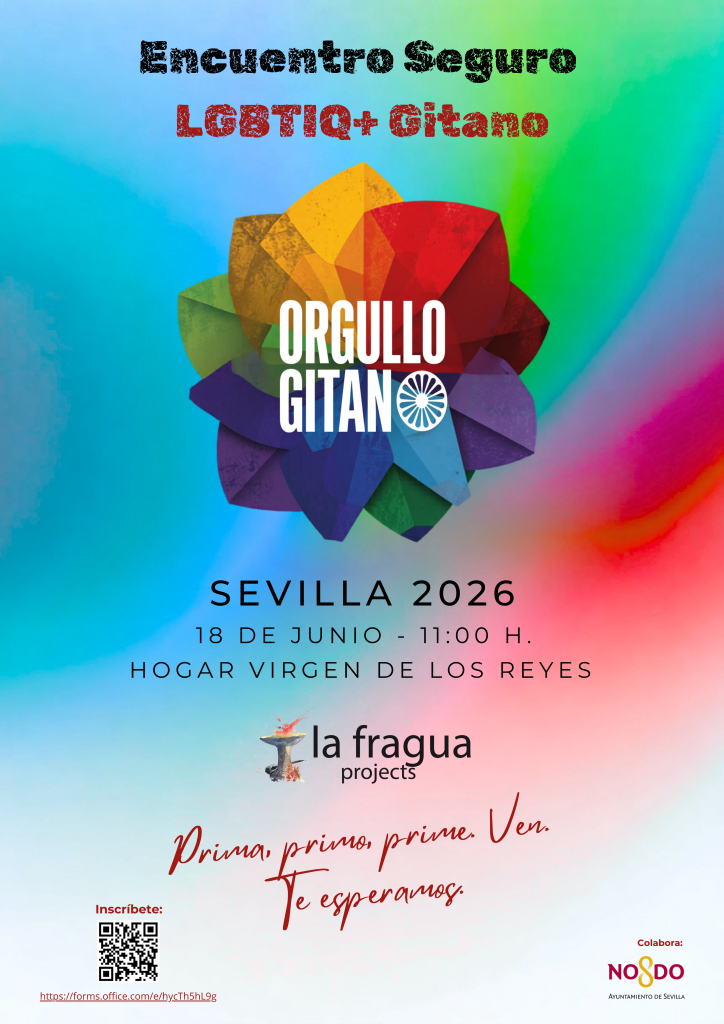
A poster has been circulating this week advertising an LGBTIQ+ Rromani Safe Gathering to be held in Seville. The event forms part of the growing number of Rromani Pride initiatives that have gained visibility across Spain in recent years. Its slogan is simple: “Prima, primo, prime. Come along, we're waiting for you.”
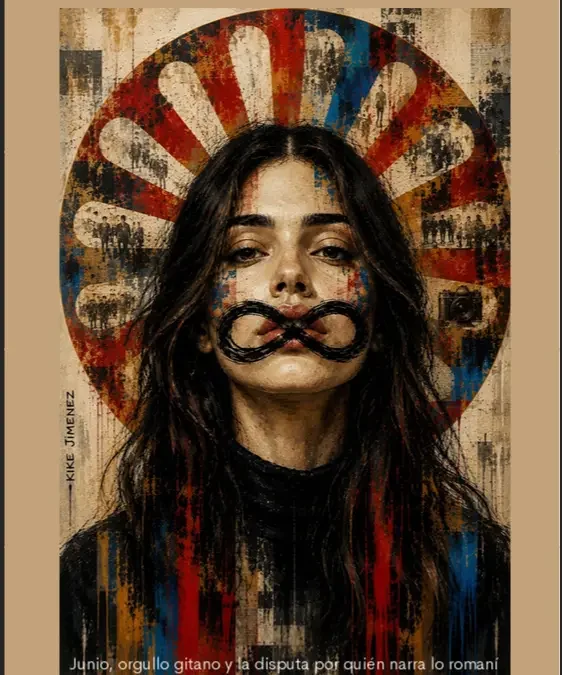
Beyond this particular gathering, both the image itself and the time of year in which it has appeared, June, Pride Month, raise a fundamental question: who has the authority today to tell the story of what it means to be Rromani?
Every era decides which images and narratives it considers legitimate and which it relegates to the margins. The history of minority communities is not written solely through laws and institutions; it is also shaped by stories, symbols and forms of representation. Few communities understand this reality better than the Rromani people.
Over more than five centuries of documented presence on the Iberian Peninsula, Rromani communities have been subjected to countless attempts by others to define who they are. Governments, intellectuals, travellers, artists and the media have all produced representations of Rromani people ranging from romantic fascination to outright stigmatisation. The result is a persistent paradox: Rromani people occupy a central place in Spain’s cultural imagination, yet remain among the least understood and most stereotyped communities in Europe.
The Rromani Pride initiatives that are emerging, or becoming more visible today, should be understood within this broader context. Their significance lies not only in the issues they seek to address, but also in the creation of new spaces from which some Rromani people are choosing to tell their own stories. As with any emerging social process, these spaces generate consensus, uncertainty, nuance and disagreement. It is probably healthy that they do.
Living cultures are not defined by the absence of debate but by their capacity to sustain it. The challenge is to avoid two common pitfalls. The first is to view the Rromani people as a homogeneous, static and unchanging group. The second is to assume that any innovation necessarily represents a break with tradition. Both perspectives flatten a far more complex historical reality.
The Rromani peoples of Europe have never constituted a single, uniform bloc. Territorial, linguistic, religious and social differences have characterised Rromani communities throughout their history. The experience of a Rromani family in Andalusia differs from that of a Rromani family in Romania, from that of Sinti communities in Central Europe, or from that of other Rromani communities in different parts of Spain. Even within the same local context, highly diverse sensibilities, life trajectories and understandings of identity coexist.
This diversity is not a contemporary anomaly. It is one of the defining historical characteristics of the Rromani people themselves. Nor have these initiatives emerged in a vacuum. For years, activists, artists and community organisations have organised meetings, campaigns and advocacy initiatives of many kinds. Recognising these historical roots does not diminish the value of current developments; rather, it allows them to be understood as part of a longer tradition of civic engagement and collective action.
Public frameworks of representation, however, tend to rely on simplification. Wider society often seeks a single image of the Rromani people: one aesthetic, one tradition, or one accepted way of expressing identity. This desire to draw clear boundaries reflects the logic of the observer far more than the reality of those being observed.
For decades, social scientists have demonstrated that collective identities are not fixed structures. They are historical processes that are continually renegotiated. Communities evolve, reinterpret traditions, adopt new languages and create new forms of belonging. Far from weakening an identity, these dynamics are often precisely what enable it to endure.
Perhaps, then, it would be more productive to shift the focus of the debate. The issue is not simply which identities emerge in the public sphere. The more important question is who has historically possessed the power to decide which lives become visible and which remain outside the collective narrative.
Representation is never neutral.
For a long time, public images of Rromani people were produced almost exclusively by outsiders. Today, new generations of Rromani writers, researchers, activists, artists and cultural practitioners are increasingly involved in shaping their own narratives. This does not mean replacing one set of voices with another. It means expanding the field of representation and recognising that no community can be reduced to a single story.
Events such as the one taking place in Seville can also be viewed from this perspective: not merely as spaces where people gather, but as arenas in which new representations of Rromani identity in the twenty-first century are being negotiated and contested.
The emergence of diverse groups and perspectives within the Rromani community should be understood, above all, as a sign of democratic maturity. A pluralistic society does not demand uniformity; it requires the capacity to live with difference without automatically perceiving it as a threat.
This principle is particularly important at a historical moment marked by political polarisation and the rise of exclusionary rhetoric in several European countries. Minority groups frequently face a paradoxical situation: they are encouraged to integrate, yet criticised when they express their internal diversity. However, no human community is free from complexity, and the Rromani community is no exception.
Recognising this reality does not mean abandoning memory or tradition. Every living culture exists in a continuous dialogue between continuity and transformation. Indeed, the history of the Rromani people is fundamentally a history of adaptation, resilience and creativity in the face of often difficult circumstances.
Perhaps the true significance of this moment lies not in any particular celebration but in something deeper: the possibility of expanding the contemporary Rromani imagination and accepting that the Rromani people of the twenty-first century, like any other people, encompass a diversity of experiences that cannot be reduced to a single image.
For diversity does not threaten a community when that community is capable of recognising itself in all its complexity. On the contrary, it is often that very complexity that ensures its survival over time.
Ultimately, the question is not who is “Rromani enough”, nor which ways of living deserve to be regarded as legitimate. The question is how to build societies in which more people can live their identities with dignity, memory and freedom.
And perhaps that is one of the most important cultural tasks of our time.
Author: Kike Jiménez, Content Director of Ijiton Magazine, a publication specialising in contemporary Rromani culture.
For the first time, the city is hosting a dedicated programme that raises awareness of the realities faced by the LGBTIQ+ Rroma community as part of Pride 2026, featuring events, theatre and cultural activities
On Thursday, Seville hosted the first edition of Rroma Pride, a pioneering initiative that forms part of the city’s Pride programme under the slogan ‘Diversity without permission, Pride without limits’. The project aims to raise the profile of the voices, experiences and demands of the LGBTIQ+ Rroma community.
The Equality Officer for Seville City Council, José Luis García, emphasised that this proposal represents a step forward towards achieving “a Pride that truly belongs to everyone and is for everyone”. As he pointed out, the LGBTIQ+ Rroma community faces a dual reality, and recognising their activism, culture and diversity represents “an act of justice and respect”.
The programme kicked off at the Hogar Virgen de los Reyes with a gathering of the Rromani gender and sexual minority community, where activists from Andalusia and other parts of Spain shared experiences and strategies to strengthen the Rromani LGBTIQ+ movement.
Debate and culture as tools for change
The event also featured discussions and round-table sessions open to the public, led by Iñaki Vázquez, director of La Fragua Projects. These sessions addressed topics such as Rromani culture as a driving force for social transformation, Rromani transfeminism, masculinities and the so-called ‘Romani closet’.
The first day concluded with a theatrical performance of ‹Puños de harina›, by Jesús Torres, at the Teatro del Hogar Virgen de los Reyes, as part of a programme combining social activism, art and reflection.
The events will continue this Friday with the launch of the books *Biopolítica del armario* and *Propaganda queer* by Javier Sáez, as part of the cultural programme for Rroma Pride.
The initiative forms part of Seville City Council’s Diversity Month, a programme through which the city commemorates LGBTIQ+ Pride and champions equality and the rights of the community in all areas of society.
Utilizamos cookies para optimizar nuestro sitio web y nuestro servicio.
Funcional
Always active
El almacenamiento o acceso técnico es estrictamente necesario para el propósito legítimo de permitir el uso de un servicio específico explícitamente solicitado por el abonado o usuario, o con el único propósito de llevar a cabo la transmisión de una comunicación a través de una red de comunicaciones electrónicas.
Preferencias
El almacenamiento o acceso técnico es necesario para la finalidad legítima de almacenar preferencias no solicitadas por el abonado o usuario.
Estadísticas
El almacenamiento o acceso técnico que es utilizado exclusivamente con fines estadísticos.El almacenamiento o acceso técnico que es utilizado exclusivamente con fines estadísticos anónimos. Sin una requerimiento, el cumplimiento voluntario por parte de su proveedor de servicios de Internet, o los registros adicionales de un tercero, la información almacenada o recuperada sólo para este propósito no se puede utilizar para identificarlo.
Marketing
El almacenamiento o acceso técnico es necesario para crear perfiles de usuario para enviar publicidad, o para rastrear al usuario en un sitio web o en varios sitios web con fines de marketing similares.