The memory of the Rroma genocide reminds us that human dignity cannot depend on a person’s origin, identity or status.
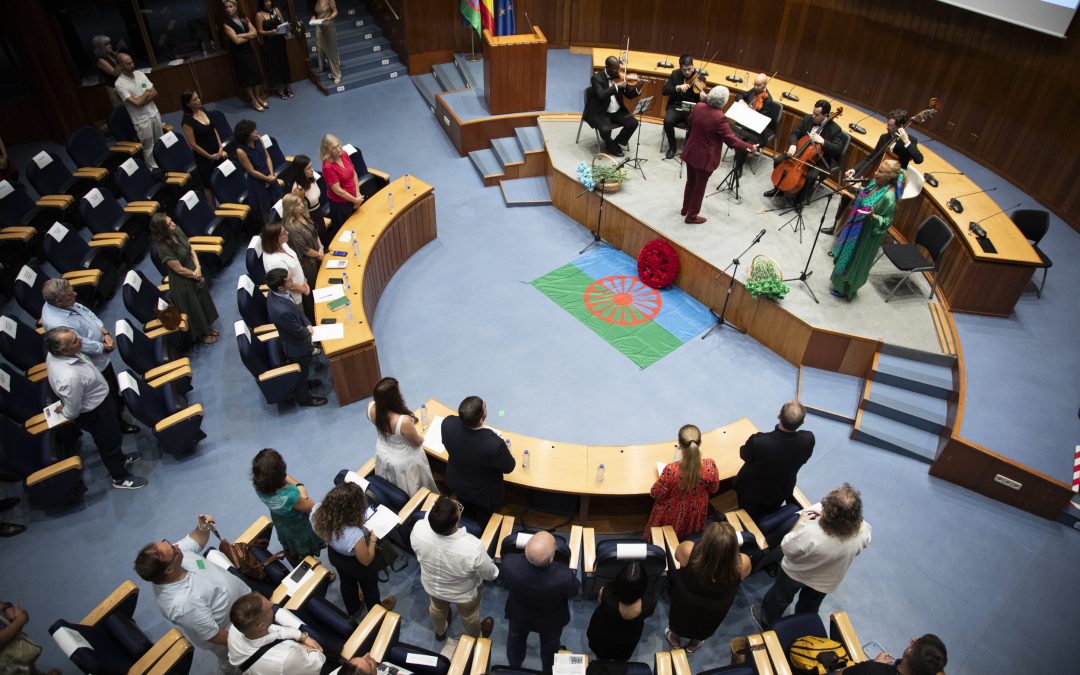
La Fragua Projects took part in the Samudaripen Memorial 2026, an event of remembrance and recognition dedicated to the victims of the genocide of the Rromani People during the Nazi era. The event brought together representatives from institutions, social organisations and Rromani organisations to pay tribute to those who were persecuted and murdered by the Nazi regime, and to call for the pledge of ‘never again’ to become a genuine commitment to human rights, equality and the dignity of all people.
The memorial was a space for remembrance, reflection and collective commitment. A place to honour the memory of those who suffered persecution and extermination, but also to reaffirm the need to continue fighting racism, intolerance and any form of dehumanisation in the present day.
Remember so as not to repeat
Samudaripen, which in Rromani means «total murder» or «the great slaughter», is the term used by the Rromani People to commemorate the genocide perpetrated by the Nazi regime and its collaborators during the Second World War. The Rromani and Sinti communities were persecuted, deported and murdered on racial grounds in a campaign of extermination that claimed the lives of hundreds of thousands of people across Europe.
2 August marks the European Day of Remembrance for the Victims of Samudaripen. The date commemorates the night of 2–3 August 1944, when the Nazi authorities liquidated the so-called Zigeunerlager or «Rromani family camp» at Auschwitz-Birkenau, murdering thousands of men, women and children who were being held prisoner there.
However, the legacy of the Samudaripen is not merely about remembering a historical tragedy. It also forces us to ask ourselves how it was possible for a society to accept that part of its population should be singled out, excluded and ultimately exterminated.
Because no genocide begins with murders.
First come the prejudices. First come the narratives that turn difference into a threat. First, discrimination becomes the norm. First, the dignity of those perceived as different is called into question.
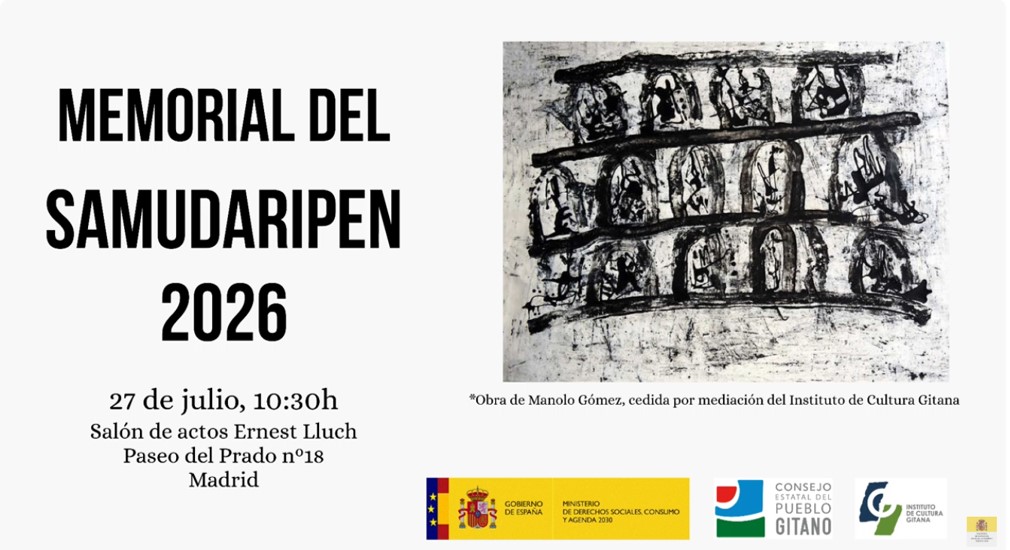
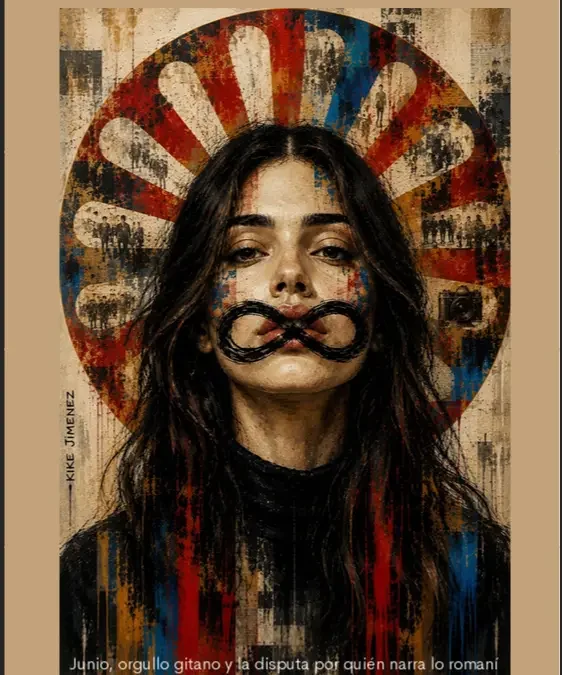
Poster for the 2026 Samudaripen Memorial
A memoir that challenges the present
For the Rromani People in Spain, this report also ties in with another pivotal episode in our history: the General Round-up of Rroma (La Gran Redada) of 1749, when approximately 12,000 Rroma people were arrested, separated from their families and deprived of their liberty in an operation designed to destroy their way of life and their collective identity.
Although separated by centuries, the Great Round-up and Samudaripen share the same root cause: the persecution of people on the basis of their origin and the formulation of policies based on exclusion.
That is why remembrance remains necessary.
We live in a world marked by armed conflict, forced displacement, hate speech and human rights abuses that affect millions of people. Given this reality, remembering the past ceases to be merely a historical exercise and becomes an ethical responsibility.
The lessons of Samudaripen remain relevant today because violence begins long before weapons are involved. It begins when we cease to recognise the humanity of those in front of us.
La Fragua Projects at the Memorial
The Samudaripen Memorial also served as a place to remember all the people and communities who were persecuted by the Nazi regime on the grounds of ethnicity, religion, sexual option, politics, ideology, or simply for being considered different.
During the event, a series of statements and messages were delivered, focusing on remembrance, recognition and a commitment to human rights, emphasising the need to build an inclusive memory that leaves no victim behind.
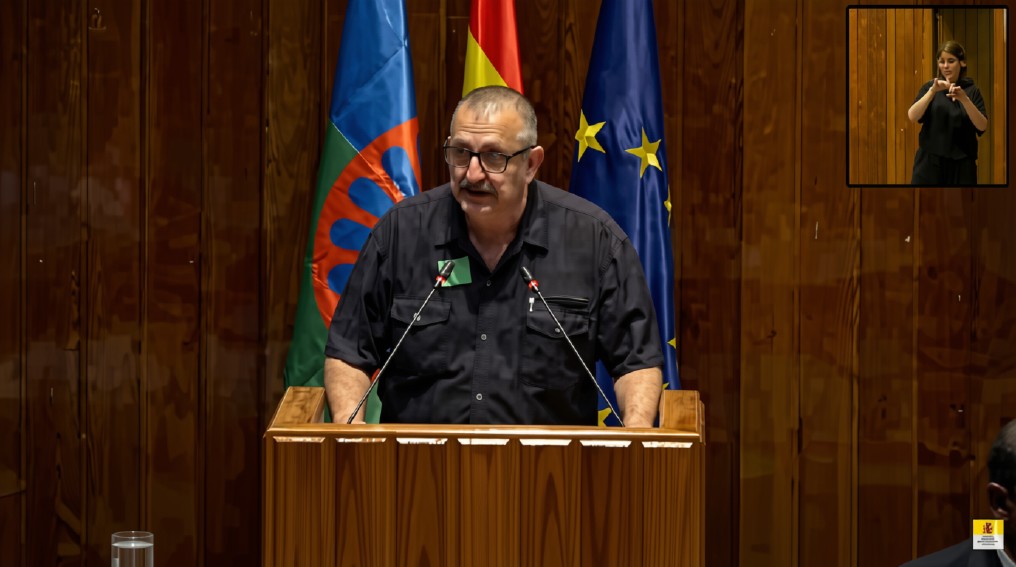
On behalf of La Fragua Projects, our colleague Iñaki Vázquez Arencón took part in one of the most moving moments of the day, saying the following:
“For all Jewish people, LGBTIQ+ people, people with disabilities and all those who, because of their circumstances, were persecuted and murdered by the Nazi regime.”
A statement which served as a reminder that memory cannot be built on the basis of forgetting or exclusion.
Remembering the Samudaripen also means acknowledging the suffering of all those who fell victim to Nazism and keeping alive our commitment to a society based on equality, diversity and respect for human dignity.
Because when a person’s dignity is attacked, the dignity of all humanity is put at risk.
Let «never again» be a genuine commitment
The Samudaripen Memorial is not merely a commemoration.
It is a call to action.
To challenge prejudices wherever they arise.
To combat racism and discrimination in all their forms.
Let us reject hate speech.
To defend human rights with the same determination for everyone.
Let us build societies where no one has to live in fear because of their background, identity, beliefs or way of life.
At La Fragua Projects, we believe that memory only has meaning when it serves to transform the present.
Because Samudaripen forms part of the memory of the Romani people, but also of the democratic memory of Europe and of humanity.
Remembering this means defending human dignity today, combating racism and rejecting all forms of hatred or dehumanisation.
Only in this way will «never again» cease to be a phrase uttered at commemorative events and become a shared responsibility with the present and with future generations.
The Madrid Summit brought together activists and organisations in Madrid to tackle LGBTIQ+ issues, in a forum where the voices of Rroma people are still missing.
On 3 July, Madrid hosted the latest edition of the Madrid Summit, MADO’s international human rights conference, which focused on defending LGBTIQ+ rights in a context characterised by polarisation, hate speech and various setbacks at a global level.
Held at the offices of the European Parliament and the European Commission in Spain, the event brought together activists, institutional representatives, experts and civil society organisations, who shared their analyses and proposals for tackling the inequalities that continue to affect the lives of this community. The full event can be watched again via the Madrid Summit 2026 broadcast.
During the Summit, key issues were addressed, such as the historical memory of LGBTIQ+ people who have suffered reprisals, trans rights, the situation of migrants and refugees, and the role of sport as a space for inclusion. The programme once again highlighted that discussing human rights means starting from the specific realities in which discrimination remains a reality.
Madrid: visibility and inequalities
Madrid is a beacon for the LGBTIQ+ movement, a space for visibility, organisation and mobilisation. But this central role coexists with a more complex reality: the city continues to be rife with inequalities, racism and LGBTIQ+phobia, which affect people differently depending on their background, social class or identity.
Not everyone in Madrid enjoys equal opportunities. For many, particularly those who belong to racialised communities such as the Rromani people, access to rights, safe spaces and a life free from discrimination remains a daily challenge.
Broadening the debate: a Rromani, anti-racist and feminist perspective
In this context, La Fragua Projects’ stance offers a much-needed perspective. As a Rromani, anti-racist and LGTBIQ+ organisation, its presence at the Madrid Summit highlights a fundamental issue: the defence of LGTBIQ+ rights cannot be understood without addressing racism, anti-Rromani sentiment and other forms of structural exclusion.
Being present in these spaces also means highlighting their limitations. At present, the participation of LGBTIQ+ Rroma People remains low in many such forums, which makes it difficult for their experiences and realities to form a central part of the debate.
It is not just about being present, but about participating on an equal footing: being heard, influencing the agenda and having a say in the decisions that affect our lives.
Rights exercised in everyday life
Talking about equality cannot be limited to mere rhetoric. It means asking who can live in safety, who is able to exercise their rights in practice, and who continues to face barriers to exercising them.
Along the way, it is also important to establish a presence, forge alliances and create spaces for dialogue – which are not always comfortable, but are necessary if we are to move towards a fairer society.
A challenge that remains unresolved
The Madrid Summit 2026 once again made it clear that LGBTIQ+ rights are not guaranteed and need to be defended constantly and collectively. But it also highlighted that such defence will only be complete if it includes all voices.
Because equality is not just about being present. It is about being able to take part in the conversation and in decision-making.
A poster has been circulating this week advertising an LGBTIQ+ Rromani Safe Gathering to be held in Seville. The event forms part of the growing number of Rromani Pride initiatives that have gained visibility across Spain in recent years. Its slogan is simple: “Prima, primo, prime. Come along, we're waiting for you.”
Beyond this particular gathering, both the image itself and the time of year in which it has appeared, June, Pride Month, raise a fundamental question: who has the authority today to tell the story of what it means to be Rromani?
Every era decides which images and narratives it considers legitimate and which it relegates to the margins. The history of minority communities is not written solely through laws and institutions; it is also shaped by stories, symbols and forms of representation. Few communities understand this reality better than the Rromani people.
Over more than five centuries of documented presence on the Iberian Peninsula, Rromani communities have been subjected to countless attempts by others to define who they are. Governments, intellectuals, travellers, artists and the media have all produced representations of Rromani people ranging from romantic fascination to outright stigmatisation. The result is a persistent paradox: Rromani people occupy a central place in Spain’s cultural imagination, yet remain among the least understood and most stereotyped communities in Europe.
The Rromani Pride initiatives that are emerging, or becoming more visible today, should be understood within this broader context. Their significance lies not only in the issues they seek to address, but also in the creation of new spaces from which some Rromani people are choosing to tell their own stories. As with any emerging social process, these spaces generate consensus, uncertainty, nuance and disagreement. It is probably healthy that they do.
Living cultures are not defined by the absence of debate but by their capacity to sustain it. The challenge is to avoid two common pitfalls. The first is to view the Rromani people as a homogeneous, static and unchanging group. The second is to assume that any innovation necessarily represents a break with tradition. Both perspectives flatten a far more complex historical reality.
The Rromani peoples of Europe have never constituted a single, uniform bloc. Territorial, linguistic, religious and social differences have characterised Rromani communities throughout their history. The experience of a Rromani family in Andalusia differs from that of a Rromani family in Romania, from that of Sinti communities in Central Europe, or from that of other Rromani communities in different parts of Spain. Even within the same local context, highly diverse sensibilities, life trajectories and understandings of identity coexist.
This diversity is not a contemporary anomaly. It is one of the defining historical characteristics of the Rromani people themselves. Nor have these initiatives emerged in a vacuum. For years, activists, artists and community organisations have organised meetings, campaigns and advocacy initiatives of many kinds. Recognising these historical roots does not diminish the value of current developments; rather, it allows them to be understood as part of a longer tradition of civic engagement and collective action.
Public frameworks of representation, however, tend to rely on simplification. Wider society often seeks a single image of the Rromani people: one aesthetic, one tradition, or one accepted way of expressing identity. This desire to draw clear boundaries reflects the logic of the observer far more than the reality of those being observed.
For decades, social scientists have demonstrated that collective identities are not fixed structures. They are historical processes that are continually renegotiated. Communities evolve, reinterpret traditions, adopt new languages and create new forms of belonging. Far from weakening an identity, these dynamics are often precisely what enable it to endure.
Perhaps, then, it would be more productive to shift the focus of the debate. The issue is not simply which identities emerge in the public sphere. The more important question is who has historically possessed the power to decide which lives become visible and which remain outside the collective narrative.
Representation is never neutral.
For a long time, public images of Rromani people were produced almost exclusively by outsiders. Today, new generations of Rromani writers, researchers, activists, artists and cultural practitioners are increasingly involved in shaping their own narratives. This does not mean replacing one set of voices with another. It means expanding the field of representation and recognising that no community can be reduced to a single story.
Events such as the one taking place in Seville can also be viewed from this perspective: not merely as spaces where people gather, but as arenas in which new representations of Rromani identity in the twenty-first century are being negotiated and contested.
The emergence of diverse groups and perspectives within the Rromani community should be understood, above all, as a sign of democratic maturity. A pluralistic society does not demand uniformity; it requires the capacity to live with difference without automatically perceiving it as a threat.
This principle is particularly important at a historical moment marked by political polarisation and the rise of exclusionary rhetoric in several European countries. Minority groups frequently face a paradoxical situation: they are encouraged to integrate, yet criticised when they express their internal diversity. However, no human community is free from complexity, and the Rromani community is no exception.
Recognising this reality does not mean abandoning memory or tradition. Every living culture exists in a continuous dialogue between continuity and transformation. Indeed, the history of the Rromani people is fundamentally a history of adaptation, resilience and creativity in the face of often difficult circumstances.
Perhaps the true significance of this moment lies not in any particular celebration but in something deeper: the possibility of expanding the contemporary Rromani imagination and accepting that the Rromani people of the twenty-first century, like any other people, encompass a diversity of experiences that cannot be reduced to a single image.
For diversity does not threaten a community when that community is capable of recognising itself in all its complexity. On the contrary, it is often that very complexity that ensures its survival over time.
Ultimately, the question is not who is “Rromani enough”, nor which ways of living deserve to be regarded as legitimate. The question is how to build societies in which more people can live their identities with dignity, memory and freedom.
And perhaps that is one of the most important cultural tasks of our time.
Author: Kike Jiménez, Content Director of Ijiton Magazine, a publication specialising in contemporary Rromani culture.
Utilizamos cookies para optimizar nuestro sitio web y nuestro servicio.
Funcional
Always active
El almacenamiento o acceso técnico es estrictamente necesario para el propósito legítimo de permitir el uso de un servicio específico explícitamente solicitado por el abonado o usuario, o con el único propósito de llevar a cabo la transmisión de una comunicación a través de una red de comunicaciones electrónicas.
Preferencias
El almacenamiento o acceso técnico es necesario para la finalidad legítima de almacenar preferencias no solicitadas por el abonado o usuario.
Estadísticas
El almacenamiento o acceso técnico que es utilizado exclusivamente con fines estadísticos.El almacenamiento o acceso técnico que es utilizado exclusivamente con fines estadísticos anónimos. Sin una requerimiento, el cumplimiento voluntario por parte de su proveedor de servicios de Internet, o los registros adicionales de un tercero, la información almacenada o recuperada sólo para este propósito no se puede utilizar para identificarlo.
Marketing
El almacenamiento o acceso técnico es necesario para crear perfiles de usuario para enviar publicidad, o para rastrear al usuario en un sitio web o en varios sitios web con fines de marketing similares.