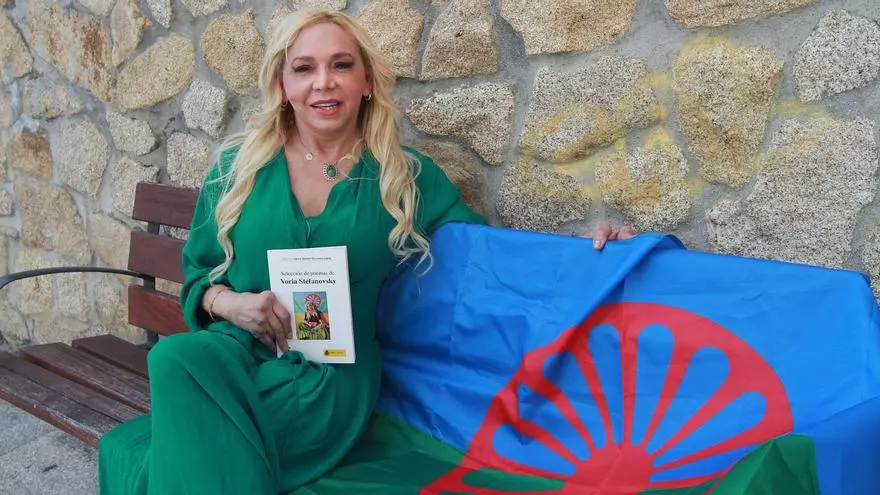
International Roma Day, celebrated yesterday, was a day of advocacy for the Rroma People. Voria Stefanovsky, an activist and academic based in Ourense, is a leading voice in the fight for her community’s dignity, and this year she is marking the occasion with a bilingual collection of poems in Spanish and Romani.
Yesterday marked International Rroma Day, an occasion that Voria Stefanovsky uses every year to stand as a beacon of advocacy and visibility for the Romani people from Ourense, a city she fell in love with a couple of years ago. She has made her home there and, from the city of As Burgas, runs the International Observatory for Rromani Women, which takes on even greater significance this year, marking 600 years of the Romani presence on the Iberian Peninsula.
However, beyond the historical commemorations, the focus is on this author, activist and academic, whose work and life are deeply intertwined with the struggles of the Rromani people.
Voria Stefanovsky holds a PhD in Literature from the University of Brasília and is currently undertaking postdoctoral research at the University of Lisbon, focusing on literature written by Rromani women. However, her most recent contribution has been a collection of poems published by the Institute of Rromani Culture, through which Stefanovsky seeks to “reclaim and restore dignity to a language which, after centuries of repression, remains one of Spain’s greatest historical debts to the Rromani community”.
The publication of this book is not an isolated event, but part of a process of raising awareness that has been developing for years and in which the Institute of Rromani Culture, a body under the Ministry of Culture, has played a key role, organising, among other things, an annual gala which has become a vital platform for showcasing the art and contributions of the Rromani people and which is held every year on 8 April.
Stefanovsky was, in fact, one of the award winners at this event, although this was back in 2022 for his research into Romani literature as part of his doctoral thesis – a milestone he hopes to repeat with his postdoctoral work, a body of writing he combines with the production of articles and poems such as those included in the Institute of Gypsy Culture’s collection.
The bilingual collection of poems
Stefanovsky’s collection of poems is not merely a literary work; it is a political and cultural statement. Through her verses, the author addresses themes that ‘run through the history of the Rromani people, because we are a transnational nation; we are present in many countries, yet we share the same culture and the same traumas’, says the writer, who counts amongst her themes ‘persecution, resistance and attempts at forced assimilation’.
Her poems, imbued with “a deeply autobiographical element”, also serve as a mirror for “the experiences of other Rromani women, because what I have been through is not unique to me; I’m sure it’s a story similar to that of many other women who have survived”, she reflects.
Among the works included in the anthology, Voria highlights the poem ‘Caminantes’, in which he reflects on ‘the history of the Romani people as a travelling people, always on the move, always persecuted, but always resilient’, emphasising the idea of a ‘transnational nation’ and the ‘constant struggle to preserve culture and identity in the face of imposed attempts at acculturation’.
What makes this collection of poems so important, apart from its message, is its bilingual format; the texts are in both Spanish and ‘Rromani, the native language of the Rromani people, which has been systematically oppressed for centuries, to the point of near extinction in many regions of Spain, such as in the south, where ‘caló’ was adopted as an adaptation of the two languages’. Thus, with the publication of this book, Stefanovsky is not only asserting his right to write in his mother tongue, but also ensuring that it becomes a vehicle for the revival and dissemination of this language.
The work is available in both physical and PDF formats, and is accessible freeof charge to encourage its reading and preservation. “It’s poetic activism,” argues this woman, who is proud to be Rromani, emphasising that “there is still a long way to go before the Rromani community receives the recognition it deserves, because it must stop being viewed as a welfare issue; what is needed is historical redress, which can only be achieved through rights and recognition.”
Roma activists are calling for an end to stereotypes and for greater recognition of diversity
Education remains a major challenge: 63% of Roma pupils do not complete their secondary education
Celia Montoya Montoya and Iñaki Vázquez Arencón joke that they are a “mismatched couple”. They have known each other for years, spend a lot of time together and share a common project: La FraguaProjects, a Romani social and solidarity economy organisation. They are activists for the rights of their people, which, they say, is a struggle for human rights.
Celia describes herself as a feminist and an actress “who works hard but doesn’t make a profit”; Iñaki describes himself as an activist—and also a gender-nonconforming activist. Neither of them fits the stereotypical moulds usually attributed to their community. Celia laments that saying she “is a feminist and a Romani woman” still raises eyebrows.
“They seem like opposites, but the strongest people I know are Romani women. Not just those in my family, but also incredibly powerful women I’ve come across in my research.” She criticises the fact that these figures are rendered invisible and that society portrays her people — and others on the margins — as the most sexist “to convince white women that they are better off and that we are the savages”.
"Society projects onto others what it does not want to be"
Iñaki agrees: “It’s the theory of otherness. Society projects onto the ‘other’ what it does not want to be. We are cast as the ‘savage’ side.” He laments that this is a dehumanising strategy: “We are homogenised in order to deny our diversity.”
To put an end to this, Iñaki Vázquez proposes a solution: “It is very important that the state provides role models for young men and women. There are lesbians, gays, bisexuals and transgender people in the Roma People – of course there are. Some have a very hard time of it and others do not. “Role models are vital, and the state must provide them, because otherwise it is complicit in all the violence suffered by these people,” he argues.
Sara Giménez, director-general of the Secretariado Gitano, highlights another aspect of this homogenisation: "There is a perception of the Romani people that is linked to exclusion or folklore. It is very regrettable to speak in this way, but all of us Roma who do not fit that image—and there are many of us—go unnoticed,” she explains. “There are many of us Roma women who have stepped forward to promote employment, to promote education, to make progress, and even to advocate for active participation in society. And almost nobody sees it,” she adds.
Celia Montoya, like many of her colleagues in the industry, has come up against the stereotypes associated with the Romani community. "In the world of film and television, if you don’t play stereotypical Romani roles, you don’t get work. I have a look that makes people see me as very ethnic or exotic. Because of that, all the roles I was offered were always linked to prostitution, marginalisation… And I’ve always turned them down, which is why I haven’t done much in film and television.”
La Cañada Real in Madrid, one of the many places where social exclusion is evident
For Celia and Iñaki, 8 April is not a day for “symbolic or institutional celebrations, or empty promises; it is a day for taking a stand”. That is why they have asked us to meet them at the Cañada Real. They want to keep the spotlight on the issue and remind people “that they have been without electricity for four years”.
For Iñaki Vázquez, the situation in this part of Madrid is a prime example of what the Roma community has always had to endure. “The state always looks the other way. Just look at what’s happening here in La Cañada. A whole host of European institutions say this is a violation of human rights, but neither the local, regional nor national governments are doing anything about it.”
600 years of the Romani people in Spain
The first historical document recording the presence of the Roma in Spain dates from 12 January 1425. Sara Giménez, director-general of Secretariado Gitano, laments the fact that, 600 years later, there is still a great deal of ignorance about them. For this reason, she calls for their history and contribution to the country’s culture to be made more widely known.
“This lack of awareness has serious consequences in terms of discrimination, the formation of prejudices and stereotypes,” which, he argues, undermine access to a dignified life, given that 86% of the Roma community lives below the poverty line: “We continue to face severe inequalities. Particularly in education, housing and employment.”
Education: the major challenge still to be tackled
According to a report by the Fundación Secretariado Gitano, 63% of Roma pupils do not complete their secondary education, whereas the figure for the general population is 4%. For this reason, they advocate investing “in specific programmes that address this disadvantage so that education—which acts as a social ladder—truly works for the Roma community, because so far it has not been working well enough”.
On the 23rd and 24th, around a hundred people gathered to discuss digitalisation among future generations of the Rroma People
The Gaz Kaló Federation, in partnership with the Public University of Navarra (UPNA), the Centre for Research and Community Action (CESPYD), the YILÓ Association of Seville and the Romani social economy enterprise “La Fragua Projects” (LFP), organised this forum to analyse the challenges and opportunities of digitalisation for Roma people within the framework of public policies and the National Strategy for Equality, Inclusion and Participation of the Roma People 2021–2030. The event was attended by prominent activists and influencers from the Roma community, coming from different autonomous communities, alongside representatives from social organisations, academia and public administrations.
On the first day, the methodology was presented by the Centre for Research and Community Action (CESPYD) in collaboration with the Public University of Navarre (UPNA), and working groups were organised across five areas: health, education, employment, housing and discrimination, to address the consequences of digitalisation over the coming decade, using the photovoice method, featuring a range of diverse voices that contributed to this process, promoting participatory processes and community action in the design of public policies, to build and envision a digital (and analogue) future free from discrimination and full of opportunities for the Roma community and for all citizens.
The event featured a roundtable discussion with Roma representatives, followed by a highly insightful debate, in which Samuel Escudero, a MásMadrid member of the Madrid Regional Assembly; Paco Vargas, a PSC councillor in San Adrián de Besós; and Pedro Aguilera, Commissioner for Citizen Participation at Barcelona City Council, took part. Among those in attendance were representatives from the Department of Social Rights of the Government of Navarre and the Parliament of Navarre; Javier Arza and Maite Esporrín, councillors for Pamplona City Council; Zaloa Basabe, Marina Curiel, Eloy del Pozo and Miguel Matellanes; and the Ombudsman of Navarre, Patxi Vera.
Also present during the event was EspacioKrea Educational Radio: the Gazteak+Sociales project run by the Navarre-based association Nuevo Futuro, in which the youngest participants took part by conducting interviews: Palmi, an activist with the Kera association in Irún; Sheyla, a young woman from Larraga who is studying for a Higher National Diploma in Pamplona; Alex, a young Roma man trained in social and healthcare support; and Natalia, a school outreach worker in the Carcastillo area.
The event concluded with a commemoration of the 600th anniversary of the arrival of the Romani people on the Iberian Peninsula and the 25th anniversary of the Gaz Kaló Federation. We received greetings from Diego Luis Fernández, director of the Institute of Romani Culture, and Carmen Santiago, vice-president of the State Council of the Romani People, as well as a live link from India with the “Ethnosfere” project, which aims to document the origins of the Romani people through audiovisual means, connecting them with the Romani community of Navarre. A moving tribute was held, including a minute’s silence for the Romani victims of the Nazi genocide, and the event concluded with a tribute to all the older Romani people who took the first steps to claim their rights, organise themselves within the Romani associative movement, and champion Romani youth.
Utilizamos cookies para optimizar nuestro sitio web y nuestro servicio.
Funcional
Always active
El almacenamiento o acceso técnico es estrictamente necesario para el propósito legítimo de permitir el uso de un servicio específico explícitamente solicitado por el abonado o usuario, o con el único propósito de llevar a cabo la transmisión de una comunicación a través de una red de comunicaciones electrónicas.
Preferencias
El almacenamiento o acceso técnico es necesario para la finalidad legítima de almacenar preferencias no solicitadas por el abonado o usuario.
Estadísticas
El almacenamiento o acceso técnico que es utilizado exclusivamente con fines estadísticos.El almacenamiento o acceso técnico que es utilizado exclusivamente con fines estadísticos anónimos. Sin una requerimiento, el cumplimiento voluntario por parte de su proveedor de servicios de Internet, o los registros adicionales de un tercero, la información almacenada o recuperada sólo para este propósito no se puede utilizar para identificarlo.
Marketing
El almacenamiento o acceso técnico es necesario para crear perfiles de usuario para enviar publicidad, o para rastrear al usuario en un sitio web o en varios sitios web con fines de marketing similares.