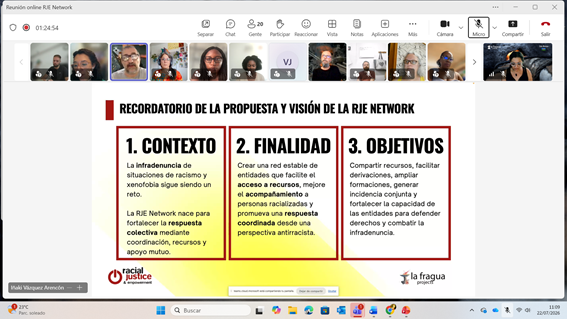
On 22 July 2026, the inaugural meeting of the Racial Justice and Empowerment Network was held; this network comprises organisations operating at national level that are committed to defending the rights of refugees, migrants, Rroma and racialised people.
The Racial Justice & Empowerment Network was established with the aim of strengthening access to rights and justice for refugees, migrants, Rroma and racialised people by creating a space for collaboration, the sharing of resources, training and mutual support. The network aims to develop coordinated responses to racial discrimination and to promote equal rights through collaboration and mutual support.
Laying the foundations for a national network
The aim of the session was to lay the foundations for the Network’s operation, defining its purpose, vision and initial coordination mechanisms. An initial assessment was also carried out of the participating organisations’ capabilities, expertise, resources and needs, with the aim of identifying synergies and establishing a shared roadmap for the network’s development.
Key objectives that will guide the Network’s work include sharing resources and knowledge amongst participating organisations, facilitating referrals and mutual support mechanisms, expanding opportunities for specialised training, developing joint advocacy initiatives, and strengthening organisations’ capacity to defend rights. Furthermore, the Network will work to improve the identification of and response to situations of discrimination, helping to combat phenomena such as under-reporting, which, in many cases, hinders effective access to justice for those affected.
During the meeting, it was also agreed to promote tools that would facilitate smooth communication between organisations and encourage the coordination of actions, thereby consolidating a stable collaborative network capable of responding to shared challenges from a national perspective.
This meeting marks the first step in a process of collective development that will help to establish a collaborative framework between organisations operating in different regions and fields of work, but which share a commitment to working towards a fairer, more inclusive and more equal society.
From September 2026, the Racial Justice & Empowerment Network will enter a more operational phase, focusing on the development of specific actions, strengthening cooperation between organisations, and implementing the priorities identified at this founding meeting to improve the defence of rights and access to justice for refugees, migrants, Rroma and racialised people.
Source: La Fragua Projects Photos: La Fragua Projects
The RJE Network brings together organisations from Barcelona and the Camp de Tarragona to strengthen the collective response to racism
The Racial Justice & Empowerment Network (RJE Network) took its first steps on 2 and 3 June with an inaugural in-person meeting at the Casal de Barri Congrés-Indians in Barcelona and at the Casal de les Dones in Reus. The meeting brought together various social organisations working to defend rights from an anti-racist and feminist perspective, with the aim of beginning to build a collaborative network to strengthen support for migrants, refugees, Roma people and racialised communities.
Although the network is still in its early stages, it already has nine member organisations. Organisations such as MigrESS, Metzineres, Médicos del Mundo, Heroïnes Anònimes and H2O took part in this first meeting, sharing their knowledge, experiences and needs in order to begin to envisage how this alliance might work in practice.
The RJE Network was established as a forum for cooperation to improve access to resources in situations where rights are violated on racist or xenophobic grounds, and to tackle under-reporting from a collective and community-based perspective. Its objectives include strengthening coordination between organisations, facilitating case referrals, sharing tools and developing joint responses to the inequalities that many people face in their daily lives.
Furthermore, the network is committed to pooling diverse knowledge and skills, promoting training, forums for exchange and advocacy initiatives that contribute to a more effective defence of human rights from an intersectional perspective.
These meetings on 2 and 3 June served not only to present the initiative, but also to launch a collective process of development. The participating organisations began to jointly define the network’s values, priorities and organisational structures, in an exercise centred on listening, care and collaborative work.
At present, the RJE Network is in a start-up phase in which the foundations are being laid: from formalising memberships to creating forums for coordination and shared tools.
The medium-term objective is to establish a stable network that will enable joint initiatives to be sustained, increase the number of organisations involved, and continue to strengthen support that is more accessible, coordinated and people-centred.
This first meeting thus marks the start of a collective journey that seeks to transform, at a community level, the conditions that allow racism and inequality to continue to restrict genuine access to rights.
Source: La Fragua Projects Photos: La Fragua Projects
The proposal by the Racial Justice and Empowerment Network was presented at the Workshop on Legal Self-Defence Against Racism in Navarre
On 13 May, we held the workshop ‘The legal framework in the fight against racism and discrimination – A workshop on legal self-defence against racism’ at the Palacete Municipal in Burlada (Navarra), as part of the Racial Justice and Empowerment 2026 project.
The event, organised by the Federation of Roma Associations of Navarre(Gaz Kaló) and La Fragua Projects, brought together around 40 people, including professionals, activists and members of the public, establishing itself as a forum for critical education, legal empowerment and collective action against racism.
The event was organised in collaboration with the Government of Navarre—through the Directorate-General for Migration Policy—and Burlada TownCouncil, and was funded by central government through the Ministry of Social Rights, Consumer Affairs and the 2030 Agenda, and by the regional government through the Department of Social Rights, Social Economy and Employment of the Government of Navarre.
Institutional representation and opening of the event
Early in the morning, the workshop was preceded by a press conference that highlighted the institutional interest in this type of initiative. The event was attended by the Mayor of Burlada, Berta Arizkun González, alongside key representatives of the Government of Navarre, such as Eva Gurría Marco, Director-General for Migration Policy. They were later joined by Carmen Remón Ochoa, from the Ayllu Service for Intercultural Coexistence and the Fight against Racism and Xenophobia; María Ángeles García Briñol, from the Intercultural Coexistence Section; and Sonia Santafé Dencausa, from the Social Inclusion and Care for Minorities Section of the Department of Social Rights, Social Economy and Employment.
This presence highlights the strategic role these spaces play as meeting points between the public sector, social organisations and the community.
From legal training to collective self-defence
The workshop was led by Paco Vargas, Pastora Filigrana and Iñaki Vázquez, with additional support from Ricardo Hernández, director of Gaz Kaló.
The presentations addressed racism from a structural perspective, framing it as a historical reality deeply rooted in both institutions and everyday life. Throughout the session, participants examined the legal framework for equal treatment and non-discrimination, as well as the various ways in which these principles are violated in areas such as employment, housing, healthcare and access to services.
Beyond the legal content, the workshop focused on the need to turn that knowledge into practical tools for legal self-defence, strengthening the ability of individuals and communities to respond to situations of discrimination.
Local action: the TECIR Network
One of the elements that particularly enriched the event was the participation of the TECIR Network (Technicians for Intercultural Coexistence and the Fight against Racism and Xenophobia), promoted by the Government of Navarre through the Directorate-General for Migration Policy.
The involvement of these professionals made it possible to link legal analysis with the day-to-day reality of social work, offering a perspective rooted in community engagement, mediation and support. Their work is essential for translating public policies into concrete practices that make a difference to people’s lives.
Social fabric and partnership-building
The event also saw the active participation of professionals from the Gaz Kaló technical team and activists from SOS Racismo Nafarroa, which helped to create a space for sharing experiences of intervention, reporting and support.
This diversity established the workshop as a hub for local collaboration, where technical expertise and community experience come together to strengthen collective responses to racism.
The Regional Law: from recognition to implementation
One of the key policy priorities was the promotion of Regional Law 13/2023 on combating racism and xenophobia in Navarre. During the workshop, its progressive nature was highlighted, whilst the need for its effective implementation was emphasised.
In this regard, the importance of utilising the instruments provided for in the law itself was emphasised, such as the Navarre Council for the Fight against Racism and Xenophobia, the development of regular plans, and the incorporation of restorative justice mechanisms as a means of prevention and redress.
Within this framework, the process of recognition and reconciliation with the Romani people took on particular significance; the law enshrines this as a commitment to remembrance, truth and historical redress. This is a pioneering measure both nationally and across Europe, with the potential to mark a turning point in the fight against anti-Romani discrimination.
It is worth noting that La Fragua Projects, in collaboration with Gaz Kaló, played an active role in the drafting of this law, drawing on its community experience and its long-standing work in the defence of rights.
Under-reporting and the right to justice
The workshop also addressed under-reporting as one of the main obstacles in the fight against discrimination, linked to factors such as a lack of awareness of one’s rights, low expectations, mistrust of institutions, and the normalisation of racism.
In light of this, the need arose to strengthen community support, improve access to resources and develop collective strategies to ensure that recognised rights are upheld.
A network to strengthen the response: RJE Network
The event also served as the launch platform for the Racial Justice and Empowerment Network, an initiative spearheaded by La Fragua Projects to establish a stable network of collaboration between organisations, professionals and activists.
This proposal aims to improve access to resources, enhance the coordination of responses to racism and strengthen advocacy capacity through collaborative efforts.
A commitment to structural transformation
The workshop forms part of a broader strategy promoted by the Racial Justice and Empowerment 2026 project, which aims to build capacity, generate critical knowledge and promote structural changes in public policy.
The Burlada conference once again highlights that legal recognition is merely a starting point. Ensuring rights means working towards their effective implementation, by strengthening both the tools available and the collective capacity to put them into practice.
In the face of systemic racism, the response must also be systemic: sustained over time, coordinated across networks and deeply rooted in the reality of local communities.
On 16 April, the Legal Self-Defence Against Racism Workshop was held at the Casal de les Dones in Reus, as part of the Racial Justice and Empowerment 2026 project.
The event, organised by La Fragua Projects, was attended by more than twenty people, including members of the public and representatives from various local organisations working with migrants and/or people of colour, such as Reus Refugi, H2O and the Madre Tierra Association.
The workshop was led by Pastora Filigrana García, a lawyer and renowned human rights activist, who began her presentation by addressing racism as a historical and structural reality that remains very much present today, both within institutions and in all aspects of daily life. Using specific examples and case studies, she analysed how the rights of racialised people are violated in the workplace, as well as in access to housing, healthcare and public services. This approach helped participants understand that discrimination is not an isolated phenomenon, but a system that determines opportunities, treatment and expectations.
An anti-racist approach to the lack of reporting
One of the key issues addressed at the workshop was the lack of reporting, shifting the focus from the victims to the barriers that prevent them from exercising their rights as citizens. The various causes and obstacles faced by migrants and/or racialised people in this area were analysed, including, amongst others, a lack of awareness of their own rights, mistrust of institutions, low expectations of redress, and the normalisation of racism. All these factors were identified, highlighting how they interfere with the ability of victims of racism and/or xenophobia to lodge complaints or reports and to demand justice and redress.
Presentation of the RJE 2025 Study Guide
During the session, the RJE 2025 Study-Guide was also presented; this is a highly practical tool designed to facilitate the reporting of acts that violate the right to equal treatment and non-discrimination on racist and/or xenophobic grounds. The document provides clear guidance on the steps to be taken and examples to assist those affected, as well as those supporting them throughout the reporting process, so that they can do so more safely and effectively.
A community space for the defence of rights
This workshop aims to establish itself as a space for collective learning where participants and organisations can share experiences, concerns and strategies to strengthen the defence of the rights of migrants and/or people of colour. The initiative highlights the importance of accessible legal training and community support in combating racism from a holistic perspective.
Source: La Fragua Projects Photos: La Fragua Projects
The 2025 reissue updates a tool launched in 2024 to make it easier to report incidents of racism and xenophobia. Available in Spanish and Catalan, it features a new visual design with original illustrations by Rocio Montoya Doblas.
What we are presenting today is a reprint of theStudy-Guide to Facilitate the Reporting of Acts Violating the Right to Equal Treatment and Non-Discrimination on Racist and/or Xenophobic Grounds, a tool launched in 2024 to provide legal information and practical resources to individuals and organisations facing situations of racial discrimination.
Produced by La Fragua Projects, the Guide is part of the Racial Justice & Empowerment project and combines analysis, reflection and practical guidance to help tackle a reality that is as persistent as it is overlooked: the under-reporting of incidents of racism and discrimination.
A tool that continues to grow
The new edition remains true to the aim with which the publication was first launched: to help people affected by discrimination to better understand their rights and the mechanisms available to defend them. At the same time, it updates the content, reviews the resources and builds on a tool that had already proved its worth in its first edition.
The publication addresses issues relating to structural racism, under-reporting and institutional responses to discrimination, whilst providing practical information on administrative, judicial and social channels for reporting rights violations.
The guide pays particular attention to everyday areas where discrimination continues to occur frequently, such as employment, housing, education, healthcare, social services, public spaces and hate crime.
A publishing venture that combines art with a unique perspective
One of the most notable features of this reprint is the inclusion of the original illustrations by Rocio Montoya Doblas, a professional Romani illustrator whose artwork complements and enhances the content of the publication.
The illustrations lend the work its own distinctive character and help to make the content – which, in many cases, relates to legal and administrative matters – more accessible. The visual approach transforms the document into a tool that engages with different forms of expression and seeks to reach a diverse audience without compromising on rigour.
This new edition also features a new layout designed by Rocio Montoya Doblas and Iñaki Vázquez Arencón, further enhancing the publication’s polished and accessible nature.
Collective knowledge for the defence of rights
The publication has been coordinated by Iñaki Vázquez Arencón and features contributions from Pastora Filigrana García and Francisco Vargas Porras, members of the Roma Professional Network set up by the organisation.
From an anti-racist and human rights perspective, the Study-Guide highlights some of the factors that continue to make it difficult to report instances of discrimination: a lack of awareness of existing procedures, a lack of trust in institutions, and the normalisation of experiences of discrimination that form part of the everyday lives of many racialised people.
A tool serving communities
Reissuing and updating this publication reaffirms our commitment to ensuring access to rights, generating useful knowledge and strengthening our capacity to respond to racism and xenophobia.
With this new edition, the RJE Study Guide continues along the path it set out on in 2024 and reinforces its aim of being a practical tool at the service of individuals, communities and organisations that work every day towards a fairer, more diverse society, free from discrimination.
Source: La Fragua Projects Illustrations: Rocio Montoya
The workshops held at La Bòbila in Porta (Nou Barris – Barcelona) and at Espai Pomezia (La Florida – L'Hospitalet de Llobregat) were attended by people who have experienced racial discrimination and members of various associations.
On 3 and 17 October, the first ‘Legal Self-Defence Workshops Against Racism’ of this year’s ‘Racial Justice and Empowerment (RJE) 2025’ project took place.
The first of these took place at the Ateneu La Bòbila de Porta in Nou Barris (Barcelona), whilst the second was held at the Espai Pomezia in La Florida (L'Hospitalet de Llobregat). For these two workshops, we were supported by the Ateneu La Bòbila de Porta and LaFundició, respectively.
The “Racial Justice and Empowerment 2025” project is funded by Barcelona City Council, the Barcelona Provincial Council and the Department of Social Rights and Inclusion of the Government of Catalonia.
Attendance at both workshops was high, and the training was attended by a range of people who have experienced racism, as well as others from various organisations representing people of colour.
Furthermore, our colleague Iñaki Vázquez Arencón, together with other members of the Roma Professional Network, highlighted the need to adopt an anti-racist approach to the issue of under-reporting, shifting the focus away from the victims and towards the sources of existing discrimination, thereby challenging the prevailing narrative that blames the victims themselves for not reporting incidents sufficiently.
The project plans to hold two workshops this year. One will take place on 17 December at the Font de la Mina Cultural Centre (Sant Adrià de Besòs) and the other the following day at the LaFede premises, run by SOS Racisme (Barcelona).
Source: La Fragua Projects Photos: La Fragua Projects
Utilizamos cookies para optimizar nuestro sitio web y nuestro servicio.
Funcional
Always active
El almacenamiento o acceso técnico es estrictamente necesario para el propósito legítimo de permitir el uso de un servicio específico explícitamente solicitado por el abonado o usuario, o con el único propósito de llevar a cabo la transmisión de una comunicación a través de una red de comunicaciones electrónicas.
Preferencias
El almacenamiento o acceso técnico es necesario para la finalidad legítima de almacenar preferencias no solicitadas por el abonado o usuario.
Estadísticas
El almacenamiento o acceso técnico que es utilizado exclusivamente con fines estadísticos.El almacenamiento o acceso técnico que es utilizado exclusivamente con fines estadísticos anónimos. Sin una requerimiento, el cumplimiento voluntario por parte de su proveedor de servicios de Internet, o los registros adicionales de un tercero, la información almacenada o recuperada sólo para este propósito no se puede utilizar para identificarlo.
Marketing
El almacenamiento o acceso técnico es necesario para crear perfiles de usuario para enviar publicidad, o para rastrear al usuario en un sitio web o en varios sitios web con fines de marketing similares.